
More articles about: Rogel Cancer Center

News Release
Xu named among Time magazine’s most influential in health
U-M Health Rogel Cancer Center research member Zhen Xu, Ph.D., was selected to Time magazine’s TIME100 Health.

Health Lab
2 multiple myeloma treatments receive FDA approval
The Food and Drug Administration approved two drugs—daratumumab and linvoseltamab—for precursor conditions to multiple myeloma and relapsed multiple myeloma. Matthew Pianko answers questions about the current treatment options for multiple myeloma, the new FDA-approved drugs and what these treatments mean for patients.

Health Lab
Brain cancer digital twin predicts treatment outcomes
A machine-learning-based approach to mapping real-time tumor metabolism in brain cancer patients, developed at the University of Michigan, could help doctors discover which treatment strategies are most likely to be effective against individual cases of glioma.

Health Lab
'Molecular glue' stabilizes protein that inhibits development of non-small cell lung cancer
University of Michigan researchers found a new protein target PP2A and developed a drug to treat non-small cell lung cancers that have KRAS mutations.

Health Lab
Leukemia drug secures FDA approval
Komzifti (ziftomenib), developed at Michigan Medicine, has been approved for patients with acute myeloid leukemia caused by the NPM1 gene mutation.

Cancer Aware
Understanding Prostate Biopsy
Those with an elevated prostate-specific antigen test are referred for a biopsy of their prostate to help diagnose prostate cancer or other prostate concerns. This can bring anxiety and discomfort for the patient.
Health Lab
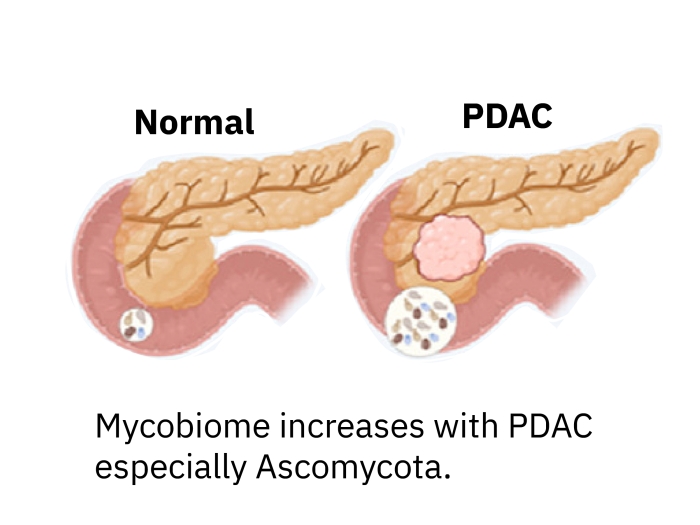
Gut microbiome may influence how patients with pancreatic cancer respond to treatment
Microbes create unique communities called microbiomes in the gut, oral cavity, skin and urogenital regions. Donnele Daley discusses common misconceptions about “healthy” microbes, the role of microbiomes in pancreatic cancer and future research directions.

Health Lab
Doctors treat lung cancer patient after cancer metastasized to her brain
Linda Rossi was initially diagnosed with lung cancer and moved to Michigan for treatment from U-M. She received surgery, but four years later the tumor spread to her brain, and she was treated with surgery and radiation.

News Release
Ribbon-cutting for new pancreatic cancer program
The Rogel and Blondy Center for Pancreatic Cancer was officially launched with a special ribbon-cutting ceremony on the sixth floor of the Rogel Cancer Center.

Health Lab
Capturing cancer cells from blood could help doctors choose the right breast cancer treatment
Doctors may be able to spare patients unnecessarily aggressive breast cancer treatments by collecting and testing cancer cells in patients' blood, study from the University of Michigan and the University of Kansas suggests.

News Release
Rogel Cancer Center names Christopher Liekweg associate director for administration
The University of Michigan Rogel Cancer Center has named Christopher J. Liekweg, M.B.A., CMPE, associate director for administration and chief department administrator.
Liekweg is a senior administrator at VCU Health, the academic medical center of Virginia

News Release
Rogel Cancer Center adds 3 new senior leadership roles
The University of Michigan Rogel Cancer has named two new deputy directors and a new associate director to provide strategic leadership in cancer care, research and training: Michael Deininger, M.D., Ph.D.; Lesly Dossett, M.D., M.P.H.; and Samuel Kaffenberger, M.D.

Health Lab
A U-M lacrosse player's rare life saving procedure in the emergency room
When a University of Michigan lacrosse player walked into an urgent care clinic with bruises on his legs and vision changes, a rare procedure available at Michigan Medicine saved his life.

Health Lab
At-home melanoma testing: Skin patch test works in mice
Melanoma testing could one day be done at home with a skin patch and test strip with two lines, similar to COVID-19 home tests, according to University of Michigan researchers.

Health Lab
Researchers find a targeted approach to shut down prostate cancer growth
Study shows a novel compound that degrades key proteins found in prostate cancer cells blocks oncogenic androgen receptor signaling.
