Engineering Better Colorectal Cancer Outcomes
Surgeon Calista Harbaugh, M.D., M.Sc., delivers quality care for patients while working to improve health outcomes across Michigan
Author |
What do gymnastics, an undergraduate degree in engineering, an M.D. specializing in colorectal surgery and a master’s in health services research have in common?
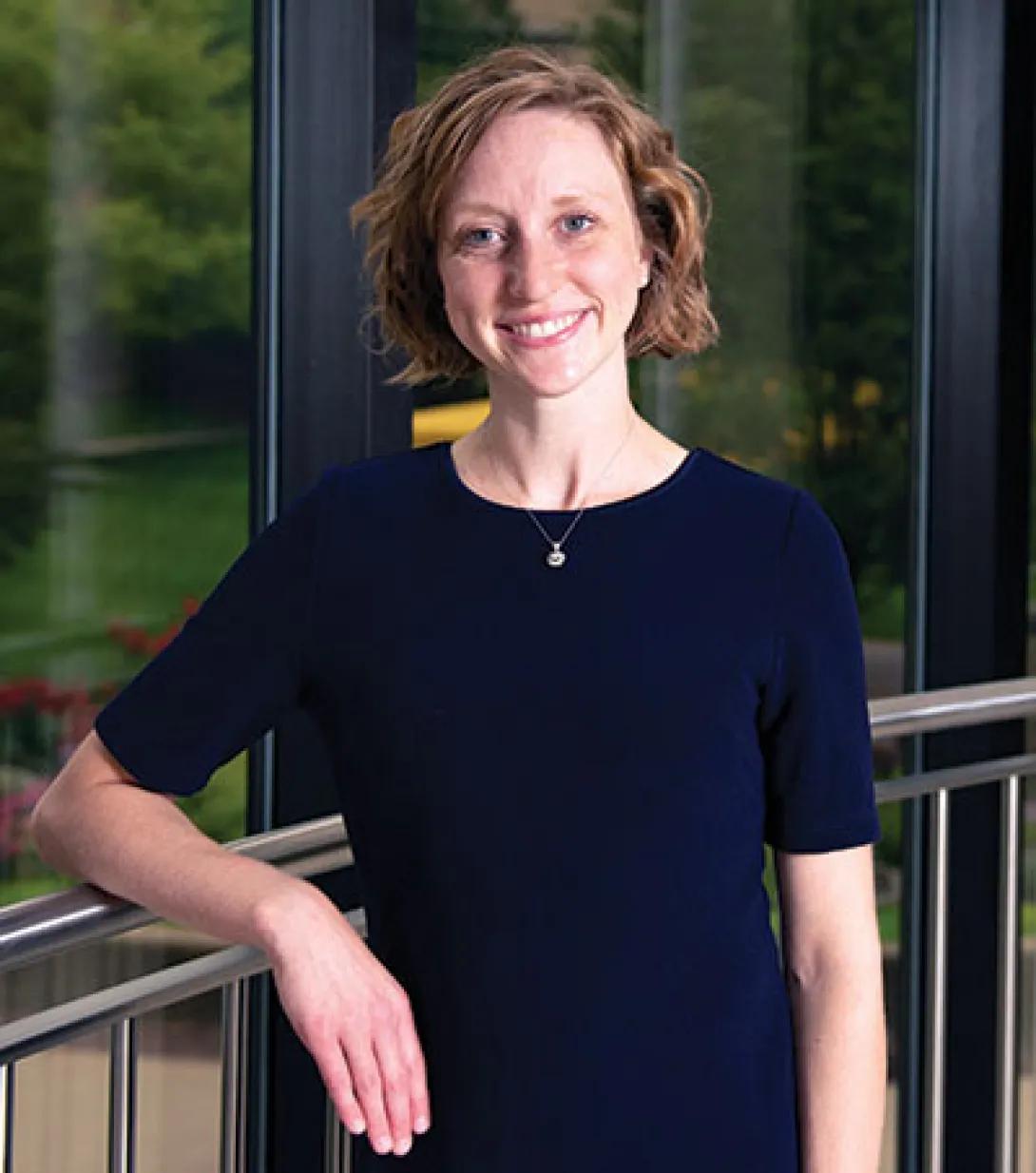
They’re the intersection of interests, training, and fire-in-the-belly that have shaped a unique career path for Calista Harbaugh, M.D., M.Sc. (pictured right), assistant professor of surgery at Rogel and a member of U-M’s Institute for Healthcare Policy and Innovation.
Harbaugh says she has always been interested in medicine, and early in her training decided to focus on biomedical engineering. Growing up, she was a competitive gymnast who suffered injuries common to the sport.
The sports medicine physicians who helped her heal inspired her to explore her options in the field.
"I wanted to be able to do that for other people, to help keep them doing the things that made them happy," she says.
Initially, she thought she’d apply her bioengineering degree from U-M’s College of Engineering to develop medical devices or innovative sports equipment.
But through medical school and general surgery residency at U-M Medical School and a colon and rectal surgical fellowship at University of Minnesota, she realized what she really loved: caring for patients at the bedside and the opportunity to translate new scientific principles to patient care.
"In medicine, I loved the specialty of surgery because it aligns with the way engineers think. It felt like a natural fit for me," Harbaugh explains.
"I really enjoy trying to understand complicated problems, and the physical aspects of surgery that allow you to try to solve those problems in the operating room."
Harbaugh treats patients with colorectal cancer as well as benign conditions such as inflammatory bowel disease and diverticulitis. Harbaugh elected colorectal surgery because it gave her an opportunity to treat common but also complex health problems.
"I liked the quality-of-life aspects of colorectal surgery," she says. "It’s lifesaving at times, and also helping patients navigate difficult decisions with regard to their quality of life."
Improving the quality of cancer care in Michigan
On the academic side, Harbaugh’s research focuses on health care quality and access, finding ways to improve health outcomes in colon and rectal cancers through initiatives that improve quality and innovations to ensure equitable delivery.
She began this work as a National Clinician Scholar in U-M’s Institute for Healthcare Policy and Innovation while earning her Master of Science degree from the Rackham Graduate School.
It’s a natural extension of her love for hands-on problem-solving. Imagine applying rigorous health services methodologies to improve the quality of cancer care and you’ve found Harbaugh’s sweet spot.
"I’m interested in figuring out how we leverage existing organizational structures like the Michigan Surgical Quality Collaborative to improve cancer care," she says. Harbaugh is working with the MSQC to apply different quality measures and understand how and why they vary for colon and rectal surgery across the state.
In related work on a larger scale, Harbaugh is looking at ways to leverage expanding health systems and hospital networks to improve the quality of colorectal cancer care.
"The landscape of health care today is that hospitals are merging into these ever-larger networks," she says. "But there’s really no good research that shows clinical benefit of hospital consolidation. That’s what we all hope they achieve but it’s not clear exactly how to do that."
These research interests align nicely with her clinical practice, most of which is located at Michigan Medicine’s Chelsea Hospital.
Many of her patients receive their care not only across multiple hospitals, but multiple health systems. Every day, Harbaugh works to navigate care coordination and make decisions that meet her patients’ quality of life needs. Many of them come from rural surrounding areas and can’t necessarily travel to Ann Arbor.
"At the end of the day my mission is to figure out how to deliver the best possible patient care closer to home," she says.
Photo credit: Paul Trombley
Continue reading Illuminate 2025
- Nurturing High-Risk, High-Reward Ideas
- Big Data, Better Cancer Care
- Wearing Your Heart (rate) on Your Sleeve
- The Right Chemistry to Keep Going
- The Future of Cancer Survivorship Care
- Tackling Pancreatic Cancer, Bench to Bedside
- The Role of Environmental Factors in Health
- Refining Radiation
Learn more:

Illuminate
Articles showcasing the latest in cancer research underway at the Rogel Cancer Center
Related
Tackling Pancreatic Cancer, Bench to Bedside
The Role of Environmental Factors in Health
Featured News & Stories

Human Rabies Exposures Growing Across the Country

Continuing the legacy of a doctor’s doctor

Dr. Elafros Receives Global Achievement Award
Karsten Bartels, MD, earns Gladys Sessler Outcomes Research Consortium Award

Into the Current: Dr. Nate Hunt Brings Specialized Water Rescue Expertise Back to Michigan Medicine