
Genetics Information and Family Testing Study
Engaging patients with inherited cancer susceptibility is a potentially powerful strategy to reduce the gap in genetic risk evaluation in their families.
The goal of the GIFT study was to engage cancer survivors to provide support to their relatives to initiate cancer genetic risk education and at-home germline genetic testing. GIFT was a 2x2 factorial cluster-randomized trial to implement and evaluate a direct-to-family, online education and communication tool including the offer of home genetic testing (see Figure 1). We partnered with the Georgia and LA County Surveillance, Epidemiology, and End Results (SEER) cancer registries to identify 4300 patients diagnosed with cancer between 2018-2019 who linked to a pathogenic variant (PV) in a clinically tested cancer susceptibility gene through a unique SEER-based data infrastructure and surveyed about four years after diagnosis. We invited all eligible respondents (recalled PV on germline genetic testing) to enroll online through our Family Genetic Health Program (FGHP). Enrolled patients could invite their eligible first- and second-degree relatives to join the study through the FGHP. The enrolled patient was randomized after consent, and relatives were then cluster-randomized by family. All participants received some level of intervention, including at least the online tool with information about genetic testing and an offer to relatives of home genetic testing through the tool. We examined the effects of two intervention features: 1) the level of family genetic risk navigation support: a technology-assisted, tailored patient and family member education and communication tool vs. the tool plus direct assistance from a lay human navigator; and 2) the cost of the genetic test offered to relatives (free vs $50, provided by Color Health). The primary endpoint was the Family Genetic Testing Fraction (the proportion of each patient's first and second-degree relatives who received testing through the tool).
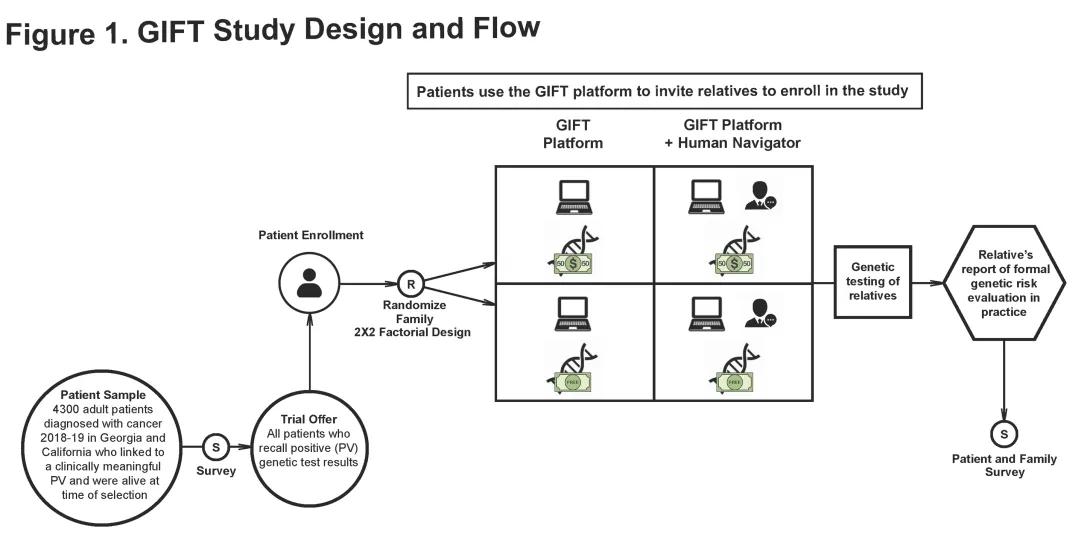
Results and Conclusion: 4,300 patients were surveyed and 2,285 (55%) responded, of whom 2,006 (88%) were eligible and invited to participate in the GIFT trial. 412 (21%) patients enrolled in the GIFT trial. Enrolled patients had a total of 5016 first- and second- degree relatives, of which 945 relatives were invited (19%). 298 (6%) relatives enrolled in the trial and 270 (5%) received genetic testing. Free vs. low-cost had a modest effect on relative test rate. There were no significant effects of the human navigator. The GIFT trial demonstrates how an online genetic risk education and genetic testing tool can be delivered to families with hereditary cancer syndromes through a population-based approach.
