
Taubman Institute Innovation Projects
Phenotyping in the Clinical Setting
Advances in technology and data science are rapidly transforming our understanding of biology, and changing the course of health care.
The ability to study disease at the molecular level, and to potentially alter genetic destiny, is rewriting the way scientists approach biomedicine.
While the role of the individual investigator still is crucial, multi-disciplinary team science increasingly is the path to actionable breakthroughs. Medical investigators are collaborating with data scientists, engineers, public health experts and others to develop new definitions and new approaches to diseases.
In 2017, the Taubman Institute launched the Taubman Institute Innovation Program (TIIP) to support these teams, with an emphasis on the use of clinical data derived from patients and research subjects. TIIP teams are encouraged to perform systematic, multiscale phenotyping to gain insights into individual variation in the susceptibility, progression, course, or outcomes of disease.
Examples include the use of data from wearable technology, to a new protocol for safely sampling fluid from the eyes of patients with ocular disease.
To date, Taubman-supported projects have attracted more than $60 million in external funding following initial investment through TIIP funding. Projects given consideration include:
- Systematic, multi-scale phenotyping (molecular, clinical device/wearable, etc) to gain insights into individual subject variation in the susceptibility, progression, course or outcomes of disease
- Development of new devices for diagnostics, tissue sampling
- Discovery related to the underlying cause of disease
- Novel approaches to prevent or treat rare diseases
- Computational tools, machine learning, and AI approaches to understand disease
Present medical care is limited in its ability to provide individualized treatment or prevention of disease. In part, this is due to a relatively small number of clinical measurements that are used to quantify relative health, and to predict disease onset, relapse and response to treatment.
The result can be over- and under-treatment, ineffective and inappropriate interventions resulting in increased medical costs, and frustration among patients and providers. The tremendous advances in our ability to obtain and integrate large amounts of clinical, molecular and biobehavioral data for an individual presents the opportunity to derive novel insights into factors that define the true state of the individual, and how these factors differ in their susceptibility, progression of disease, and response to disease interventions.
The ability to phenotype patients is often limited by space, clinician time, support personnel, clinic demands, phenotyping infrastructure, database availability, bioinformatics support, etc., that are difficult to put into place, but would be important to obtain external funding. The Taubman Institute hopes to help fill these gaps.
TIIP calls for application generally are held each fall. For more information, contact Taubman Institute Managing Director Grace Wu via [email protected]
Current Taubman Institute Innovation Projects
Principal Investigators:
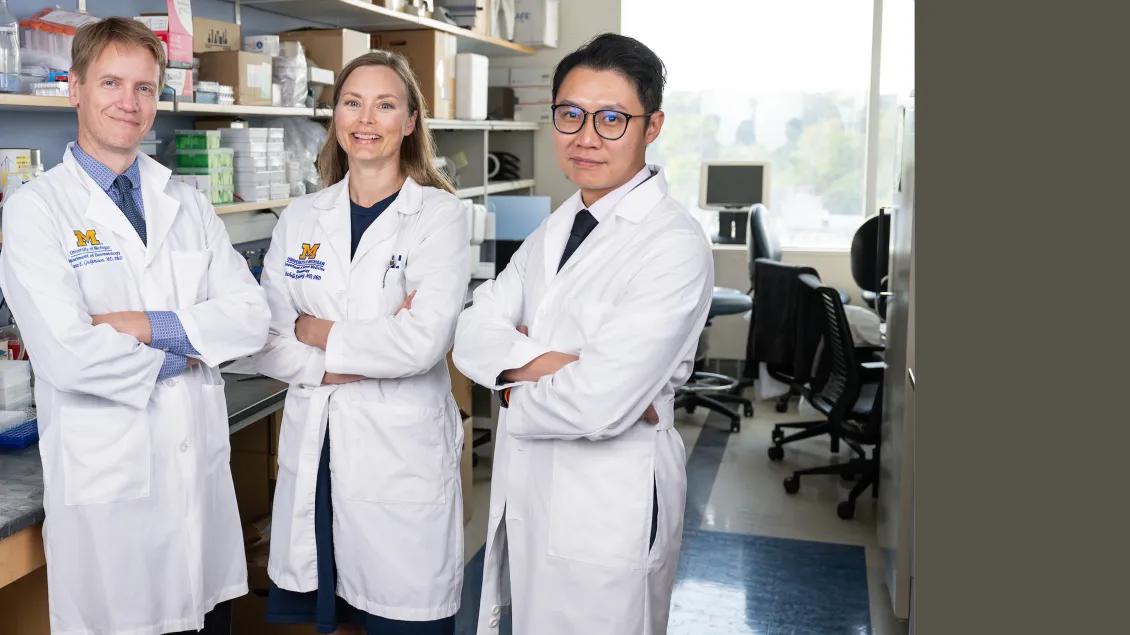
Michelle Kahlenberg, MD, PhD and Johann Gudjonsson, MD, PhD
Advances in autoimmune disease understanding and treatment have progressed slowly. Some diseases, such as systemic lupus erythematosus (SLE), have seen only one approved medication for disease treatment in the past 50 years.
The reasons for this delayed progress are multiple but include the lack of organized cohorts of less common diseases, individual heterogeneity of these complex conditions, which makes it difficult to predict treatment response, and an overall lack of understanding of disease mechanism.
This team's program, "Personalized Medicine through Integration of Immune Phenotypes in Autoimmune Skin Disease (PerMIPA)," aims to overcome these deficiencies by creating the infrastructure to study and involve the large autoimmune patient population at the University of Michigan in our research programs.
PerMIPA aims to develop a personalized medicine approach to understand the predictors for medication response in patients, and to leverage and integrate state of the art technologies to understand disease mechanism.
The objective of this program is develop a longitudinal cohort of psoriasis and SLE patients that will be carefully phenotyped (both clinically, genetically, and immunologically using state-of-the art technology) coupled with longitudinal and targeted sample collection for mechanistic studies.
Principal Investigators: Sung Won Choi, MD and Muneesh Tewari, MD
Chimeric antigen receptor T cell (CAR-T) therapy has dramatic anti-tumor effects in patients with cancer, but a major barrier to its broader application is the potentially life-threatening toxicity known as cytokine release syndrome (CRS).
Our team is performing a comprehensive study of cytokines and immune cell changes in CRS as it is evolving, prior to obvious symptoms, which is yielding new candidate biomarkers for earlier CRS detection, as well as identifying new therapeutic strategies for preventing CRS.
Principal Investigator: Peter Todd, MD, PhD
Short repeating sequences in human DNA known as STRs make up about five percent of the human genome. Repeat expansions are the most common known genetic causes of ALS, Frontotemporal Dementia, Ataxia, and Autism.
This team's hypothesis is that STRs throughout the genome contribute to human neurological disease on a scale that is currently significantly underappreciated. To test our hypothesis, we’ve assembled a diverse team of scientists with expertise in genome structural variation, novel tool development, and human neurologic disease modeling to build a pipeline that will define both novel mechanisms by which repetitive elements elicit neuronal dysfunction and the broader roles STRs play in human disease.
Principal Investigator: MeiLan Han, MD, MS
Despite the fact that COPD is one of the leading global causes of death, the majority of patients are diagnosed late in the disease.
The goal of this study is to understand how to identify an early disease patient population within a health system to leverage for the development of disease modifying therapies.
Principal Investigator: Thomas Gardner, MD, MS
Dr. Gardner is Professor, Ophthalmology and Visual Sciences, Professor, Internal Medicine – Metabolism, Endocrinology, and Diabetes, Professor, Molecular & Integrative Physiology, Senior Scholar, A. Alfred Taubman Medical Research Institute, and Associate Chair, Research
This team's goal is to develop a safe and effective vitreous biopsy device to acquire vitreous fluid from the eye for the diagnosis of ocular diseases.
The device will be a tool for retina and uveitis specialist use in the office setting with immediate demand at launch for use in diagnosis and pathogen detection in patients with acute infections within the eye.
Longer-term, the device will facilitate precision medicine in ophthalmology with potential to guide therapy selection in patients with ocular inflammation, diabetic retinopathy, macular degeneration, glaucoma, and other ocular diseases that result in disabling vision loss.
NPOP Long-term Adult Clinical Trial & Pediatric FDA Submission Preparation
Principal investigators: Jeffrey Plott, PhD; Louise O’Brien, PhD, MS, and David Zopf, MD, of the University of Wisconsin
This team has developed a device to help people who have trouble breathing because their upper airway gets restricted. (NPOP stands for nasopharynx and oropharynx, two breathing-related structures in the throat.)
The device is a soft, flexible, medical‑grade silicone piece that fits into the nose. It helps keep the airway open by gently supporting the tissues that can collapse and block airflow, making breathing easier. In addition to addressing sleep apnea in adults, the device is promising for children whose health conditions can make throat muscles extra weak—such as cerebral palsy, Down syndrome, and Pierre Robin sequence.
Principal investigators: Andrzej Dlugosz, Zhen Xu, Guizhi Zhu, Paul Swiecicki, Monique Verhaegen, Paul Harms, Johann Gudjonsson, Lam (Alex) Tsoi, Marcin Cieslik, Allison Furgal, Tarek Haykal
This project will test new treatment options for a rare and aggressive skin cancer called Merkel cell carcinoma. The team will use a unique mouse model that closely mimics this cancer in humans, in order to safely study potential therapies before trying them in patients.
The treatments researchers plan to test include:
- Novel drugs and drug combinations that include immune activators
- A new type of cancer vaccine designed to help the immune system attack the cancer
- A cutting‑edge ultrasound treatment called histotripsy, which uses sound waves to break up tumor tissue without surgery
Principal investigators: Ashley Bartell, MD, PhD; Santhi Ganesh, MD; Johann Gudjonsson, MD, PhD; Olesya Plazyo, PhD; Lam (Alex) Tsoi, PhD
The biology of hypertensive disorders of pregnancy- like preeclampsia- involves changes in the placenta as well maternal blood vessels. Few studies address the structural and functional differences across these tissues in pregnancies affected by hypertensive disorders compared to unaffected pregnancies.
This limits physicians’ understanding of how to prevent and treat hypertensive disorders, which can have lifelong consequences. The PREGX study will collect and study samples of the placenta along with maternal tissues, establishing a repository of data to be used in studying the causes, complications, and long-term effects of hypertensive disorders at the molecular level.
The TIIP Application Process
Who should apply?
Only University of Michigan scientists are eligible.
The Taubman Institute welcomes applications from existing teams of active collaborators, newly formed teams, or from individuals who have novel ideas.
What is the review process?
Initial letters of intent will be reviewed by the institute and its appropriate partners, with the teams having the opportunity to provide clarification. Meritorious applications will be asked to submit a more extensive proposal which will provide details of the primary aspects of the project and funding needs.
The projects selected for advancement to the second phase will be invited to work with the institute to develop a plan for potential implementation. These proposals will be evaluated by internal and external experts and other relevant stakeholders prior to final decisions regarding funding.
Funding criteria:
- Beneficial impact on patients
- Innovation in understanding the variability in onset or progression of disease, and reasons for differential response to treatment
- Potential for future funding by the NIH or other external agencies
- Potential for increased reimbursement for care by insurance companies, or cost savings to the medical system
- Enhanced interactions with basic or other science disciplines (teams)
Letter of intent requirements:
- Description of the proposed program
- Who is going to work together and what will be their roles? Have you worked together in the past?
- Where do you want to perform this work?
- What infrastructure is needed to accomplish the goals?
- Who will you need to partner with to succeed?
- What are the present barriers to your success?
- What are your plans for downstream funding?
Note: not all of these points must be addressed in the LOI. We seek to understand your vision for bringing science into the clinic. The main request here is for an outline of what you want to do and why it will be impactful.
There is no deadline. Letters of intent are accepted on a rolling basis, and should be submitted to Managing Director Grace Wu ([email protected]).
Questions?
We encourage questions, and we are happy to meet with individuals or teams to discuss ideas.
