

Learning Health Sciences: Implementation Science Research
The U-M Medical School Department of Learning Health Sciences' Implementation Science (IS) initiatives align innovative informatics, global health, simulated learning, and community engagement methods that strive to improve health and healthcare in clinical and community-based settings.
The department's Implementation Collaborative formed the U-M Implementation Science Network (ISN) in 2021 to connect researchers to promote more innovative and impactful initiatives, making U-M a destination for innovative, interdisciplinary implementation science and practice in communities and health systems.
For More Information
Implementation Science Network Goals
The ISN is maintained by the Michigan Institute for Clinical and Health Research (MICHR).
MICHR, a Clinical and Translational Science Awards (CTSA) Program, uses translational science to identify and remove persistent roadblocks in the research pipeline, including challenges related to research design and implementation or within the structures and processes that facilitate research.
Our Implementation Research Initiatives
Our department's implementation research initiatives identify, refine, and test implementation strategies in health system and community-based settings:
- Implementation of diabetes self-management practices in community-based settings (Gretchen Piatt)
- Sequential multiple assignment randomized trial (SMART) designs and adaptive implementation strategies to reduce health disparities in cardiovascular disease (Amy Kilbourne, DECIPHeR Initiative)
- Implementing group-based antenatal care in Ghana to improve maternal and newborn outcomes (Cheryl Moyer)
- Nurse staffing (Rama Mwenesi) and pay-for-performance implementation strategies in surgical settings (Amy Kilbourne, with the Michigan Surgical Quality Collaborative)
- Implementing Learning Communities for persons with bipolar disorder (Alexandra Vinson, with the Heinz C. Prechter Bipolar Research Program)
- Virtual reality simulation for cardiac arrest (Vitaliy Popov) and the Out of Hospital Cardiac Arrest Learning Community
- Data-driven methods to improve learning communities and environments (Andrew Krumm) with the Rogel Cancer Center
- Implementing precision audit-and feedback to improve practice (Zach Landis-Lewis)
- VA-focused implementation science and research related to antimicrobial stewardship (John Donnelly)
- Implementing patient engagement strategies to improve shared decision-making (Tanner Caverly)
Educational Opportunities
Department of Learning Health Sciences Courses
- LHS 621: Implementation Science in Health I (3 credit courses), taught by Rama Mwenesi Musalia, PhD and John Donnelly, PhD
- LHS 721: Implementation Science in Health II (3 credit course) taught by Amy Kilbourne, PhD
MICHR Resources
- Implementation Science Career Toolkit: The toolkit was originally developed in 2022 by Michele W Marenus, Amy Kilbourne, Anne Sales, and Celeste Liebrecht in partnership with the U-M Institute for Healthcare Policy and Innovation.
VA Quality Enhancement Research Initiative (QUERI)
- QUERI Roadmap for Implementation and Quality Improvement
- Problem-focused: multi-level operations input
- Flexible timelines: rapid, rigorous
- Infrastructure planning, technology, policy
- Research & QI protocols coexist
- Researcher and clinician training opportunities
- Sustainment plan (ownership) to operations
- QUERI training opportunities in implementation and evaluation science in the real-world settings
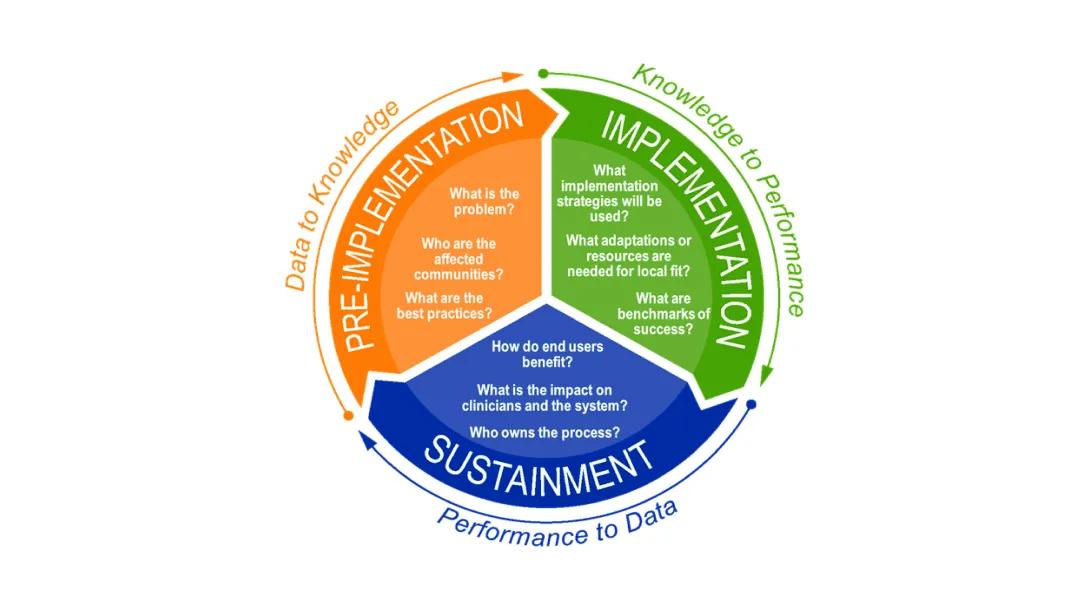
The loop presents overarching questions/issues facing each phase of a Learning Health System.
These phases and functions map onto the Learning Health Systems framework’s 3-part cycle of integrating data and new evidence into practice of: (1) data to knowledge; (2) knowledge to performance; and (3) performance to data.
Each phase of the implementation process requires active participation of stakeholders including consumers, frontline clinicians, health care administrators, and leaders/policymakers.
