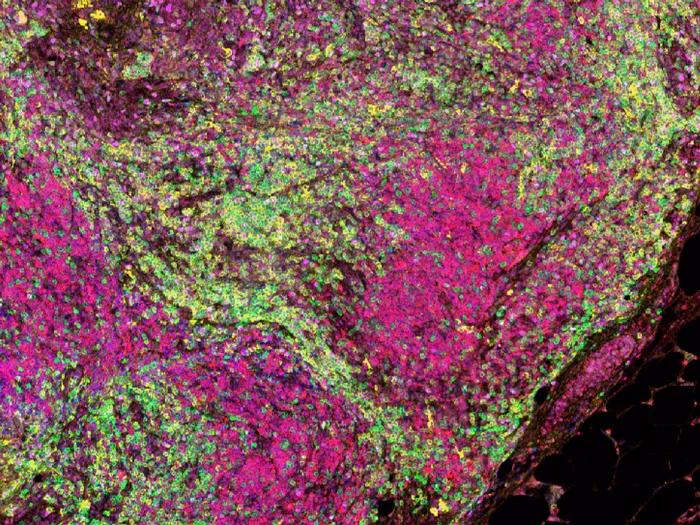
Cancer Genetics Research

Understanding the role of genes in cancer development and progression
The mission of the Cancer Genetics Program is to advance knowledge of the genetic and epigenetic mechanisms that underlie the development and progression of cancer. Our team members are committed to the pursuit of knowledge that will inform the understanding of not only the origins of cancer, but the nature of cancer within unique environments. We seek to uncover new preventive and early diagnostic approaches for cancer and also to improve the clinical management of cancer patients.
Led by program co-leaders Kathleen Cho, MD and Goutham Narla, MD, PhD, the Cancer Genetics Program is an interdisciplinary basic science research group comprised of members from the University of Michigan Medical School, School of Public Health and College of Literature, Science, and the Arts. We work collaboratively across the Rogel Cancer Center Basic Science Programs, and integrate translation of research through the Clinical Research and Cancer Control and Population Sciences divisions.
Key Research Themes in Cancer Genetics
The Cancer Genetics Program has four major research themes:
- Genetic and epigenetic mechanisms contributing to genomic instability in cancer
- Genetically engineered mouse models for investigating the role of recurrent gene defects in cancer pathogenesis and employing these models in pre-clinical studies directed at improving prevention, early detection and treatment of cancer
- Mechanisms of gene regulation by transcription factor and chromatin modification complexes and other factors in cancer cells
- Oncogene and tumor suppressor gene network defects, and gene expression and epigenetic signatures in cancers of various types
Cancer Genetics Specific Aims
Aim 1: Mechanisms
Elucidate the genetic and epigenetic mechanisms of cancer development and progression.
Aim 2: Models
Utilize novel animal model systems for characterizing the impact of critical genetic alterations found in human cancers.
Aim 3: Translation
Generate new knowledge for translation into effective strategies for cancer prevention, early diagnosis and treatment.
Quick Links
Models Lead to Greater Understanding of Tumor Biology
By studying cancer tumor development and the role of recurrent gene defects in mouse models, the timing and location of cancer mutations can be identified within the microenvironments to better understand the tumor biology. For example, our team is creating novel mouse models of colorectal and ovarian cancer to not only determine key aspects of human disease, but also provide valuable tools for preclinical studies directed at improving the control and treatment of cancer.
Personalized Medicine through Genetic Research
An example of knowledge generated through the Cancer Genetics Program is the discovery of genetic and epigenetic markers that can help guide decisions about cancer prevention, diagnosis and treatment.
This personalized or patient-centric approach to medicine allows the complete DNA and RNA sequence of a patient’s tumor to inform treatment decisions. By examining the DNA sequence of tumor cells, our researchers can identify mutations that cause cancer, better predict response of a given tumor to available therapies, and direct patients toward appropriate clinical trials testing new therapies.
New Strategies to Target Notch Pathway
Another research focus by Cancer Genetics Program team members includes finding new strategies to target the Notch pathway, which has a wide range of physiological roles, such as cell fate determination, proliferation, survival and the immune response. Our goal is to selectively target Notch in cancer, while preserving its essential normal functions, and without causing unacceptable toxicities or cancer promotion.
These research efforts have made an important contribution toward developing a precision medicine framework for treating patients with various types of cancer. The findings are expected to lead to innovative ways to diagnose and treat these cancers.
Shared Resources Excellence Supports Cancer Genetics Program
Cancer Genetics Program members benefit from using the University of Michigan Rogel Cancer Center Shared Resources to support innovative cancer genetics research. These exceptional resources provide the highly specialized technology and expertise required to advance scientific discovery. Specific Shared Resources used by the Cancer Genetics Program include:
- Biostatistics, Analytics & Bioinformatics
- Flow Cytometry
- Tissue & Molecular Pathology
- Transgenic Animal Models
- Structure and Drug Screening
Collaboration Enhances Discovery
In addition to the collaborative support from Shared Resources, the Cancer Genetics Program is expanding collaboration with the Signaling and Tumor Microenvironment Program and the U-M Medical School’s Department of Pathology in the area of epigenetics to enhance discovery. Our members also are increasing inter-programmatic collaboration to stimulate discovery both between members of the Cancer Genetics Program and with other Rogel Cancer Center members.
Work With Us
NOTE: Available to University of Michigan faculty only
Meet our Leaders

Kathleen R Cho
Associate Chair for Academic Affairs
Department of Pathology
Medical Director Gynecologic Pathology
Professor of Pathology
Professor of Internal Medicine

Goutham, Narla, MD, PhD
Professor of Internal Medicine
Professor of Human Genetics and Program Assistant
Internal Medicine
Medical School
News & Stories

Online resources and coaching helped people seek genetic testing for cancer
Path forward for glioblastoma treatment
Study explains how colorectal cancer cells maintain high iron levels

Stopping Ewing sarcoma relapses where they start
Study sheds light on how early pancreas lesions become cancerous