Radiology Medical Student Programs
Radiology is at the center of medicine and is used by most physicians over the course of their careers.
This is why the U-M Medical School Department of Radiology aims to offer education in radiology starting with our involvement with the first-year anatomy curriculum. We have faculty and residents who contribute their applied anatomy knowledge and how it relates to normal anatomy and basic pathology within the lectures and labs.
For More Information
The Department of Radiology is committed to introducing medical students to the essential role of imaging in patient care. Our radiology-anatomy correlation lecture combines detailed anatomical instruction with highly visual examples from X-ray, CT, MRI, ultrasound, PET, and nuclear medicine imaging. Students also learn the history, physics, and image formation principles behind each imaging modality.
By correlating anatomy in living patients with normal physiology and disease, these sessions help students understand the clinical relevance of anatomy, increasing both engagement and knowledge retention.
The Michigan Radiology Interest Group (MRIG) further enhances student learning through case-based radiology discussions and hands-on ultrasound workshops.
In addition, the department offers six second-year medical student electives:
- Emergency Radiology
- Interventional Radiology
- Women's Imaging
- Pediatric Radiology
- Neuroradiology
- Ultrasound
Introducing radiology early in medical education helps students recognize the critical role radiologists play in diagnosis, treatment, and patient care while exploring the many subspecialties within the field.
Goals of the Program
- Introduce students to imaging acquisition and image guided procedures
- Apply appropriate imaging criteria to common clinical scenarios in both the inpatient and outpatient setting
- Identify normal radiologic anatomy and common pathology diagnosed with imaging
- Understand the role of radiologist in clinical care
What You Will Learn
Year 1 (Scientific trunk): Radiology small groups throughout the first year are focused on teaching radiologic anatomy and are coordinated with the anatomy curriculum. Additional multidisciplinary lectures allow students to see common pathologic conditions and their imaging appearance.
Year 2 (Clinical trunk): Radiology lectures are provided during the transition to clerkship introductory course. Students spend one week in radiology during the Surgery and Applied Sciences rotation where pathologic imaging findings are further taught to build on material the students have learned in the first year.
Years 3 and 4 (Branches): Students in the diagnostic and therapeutic branch participate in ultrasound curriculum with the radiology and emergency departments. Radiology electives including subspecialty rotations and a general radiology elective which exposes students to multiple subspecialities over a month-long rotation. These electives allow student to spend time in the reading room and procedural suites working closely with our residents, fellows, staff and faculty.
Branch Electives
This is a structured elective emphasizing the use of diagnostic imaging in patient management. Whether you are taking the clinical rotation or have chosen a sub-specialty, you will have the opportunity to enhance knowledge and skills pertaining to interpretation of images, clinical judgment, and therapy and advice to patients - especially with regard to radiology utilization.
At the termination of the elective, the student should be able to:
- Construct a list of the available imaging studies in the subspecialty
- Communicate the indications and limitations of the imaging studies used in the subspecialty to patients and colleagues
- Describe how the imaging studies in the subspecialty are performed to patients and colleagues
- Discuss the relative costs of the imaging studies available in the subspecialty
- Solve typical clinical problem algorithms for imaging related to the specific subspecialty
- Indicate which read-outs and conferences in the section the student attended
- List which related topics and diseases the student researched for additional reading
- Give an oral presentation of a new teaching file case researched and prepared for the subspecialty teaching file
- Determine the student's own abilities and limitations in evaluating imaging studies
- Understand some of the thought processes and judgment used by a radiologist in issuing a report on an imaging study
M4 Berg Prize
In 1983, Dr. Berg established the Roger A. Berg Prize in Radiology, which is awarded each year to a fourth-year medical student.
“When I was growing up,” said Dr. Roger A. Berg (BS ’57, MD ’61), “my father passed on to me a sense of gratitude for all he had received from the University of Michigan and he stressed the importance of giving back.”
Berg’s father, Dr. Albert Berg (AB ’28, MD ’32), “was grateful to the U-M his whole life for the chance to earn his medical degree,” said Roger, whose gratitude has manifested itself in many ways. As a third- and fourth year medical student, Roger collected money on the street corners of Ann Arbor during the annual December Galens Medical Society effort to support local children’s organizations.”
Berg Prize Recipients
- 2026 - Melis Ozkan and Griffen Kingkiner
- 2025 - Sidney Torres
- 2024 - Renaid Kim and Nina Maghsoodi
- 2023 - Colby Foster
- 2022 - Gabe Walker
- 2021 - Hannah Lamberg
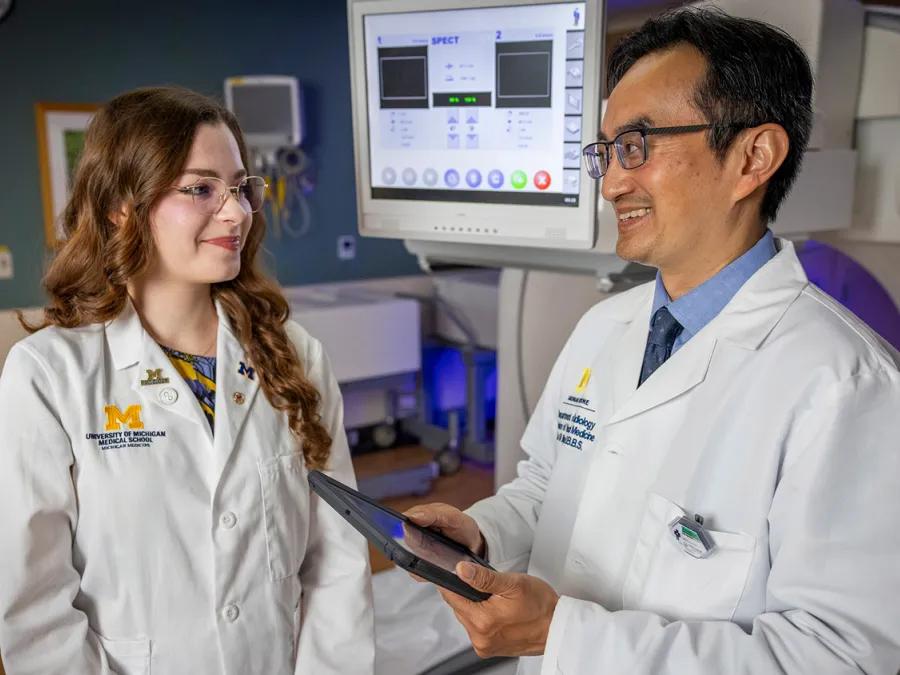
Michigan Radiology Interest Group
Supporting l students interested in learning more about the fields of Diagnostic and Interventional Radiology by providing regular informative meetings, social gatherings, a mentoring program, career counseling and a positive atmosphere.
Program Leadership
Molly Roseland, MD
Program Assistant
OMSE Content & Discipline Lead
Medical School