
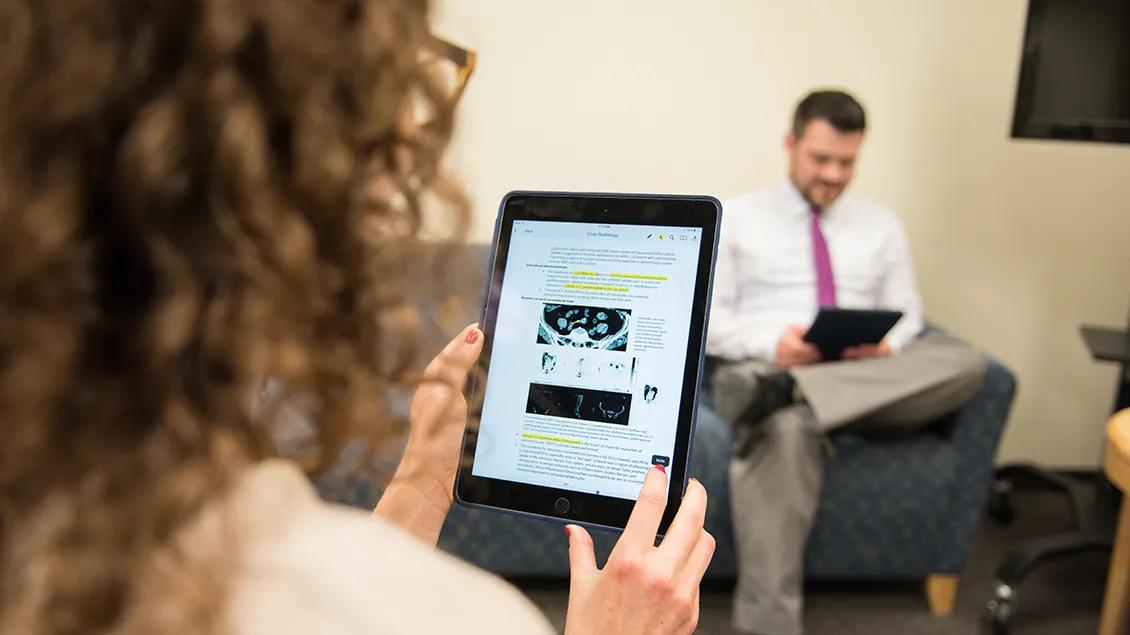
Rear view of a woman studying MRI data on a tablet screen

Radiology Professional Development

At the U-M Medical School Department of Radiology, there are several different internal training pathways for gaining sub-specialty training while completing your residency.

Leadership Development

While at U-M Medical School, residents have the luxury of being at a world class university and its associated graduate programs. This gives our trainees unique opportunities to pursue and develop additional areas of interest, particularly in research, business, innovation and education.

Leadership Tracks

The Leadership Training Tracks are designed to develop national leaders in radiology through specialized pathways in Research (NIH T32), Health System Administration, Education, and Information Technology. 

Across all tracks, residents engage in a common leadership curriculum in partnership with the Michigan Ross School of Business and build leadership competencies through mentorship, visiting professor interactions, and project-based symposia. 

Each leadership track culminates in a capstone project designed to translate learning into impact. Residents design and lead a formal initiative—developing proposals, managing teams, and delivering measurable outcomes that demonstrate their ability to lead and innovate on a national scale.

Research Leadership Track (NIH T32)

Track Leaders: Vikas Gulani, MD, PhD; Nicole Seiberlich, PhD; Peter Scott, PhD

Year One: Identify research mentors and begin integration into research groups

Year Two: Continue research projects and apply for NIH T32 Michigan Translational Imaging Program (M-TIP)

Year Three: Participate in M-TIP didactic activities along with research project

Year Four: Continue M-TIP didactic activities along with research project and complete research
capstone in the form of a presentation of publications or grant proposal

Health System Leadership (RLI-Aligned)

Track Leader: Elaine Caoili, MD, MS

Year One: Establish a mentoring relationship with one national leader outside U-M

Year Two: 

Year Three: Complete RLI Health Care Economics Milestones Program

Year Four: 

  • Get an executive coach
  • Undergo a formal 360
  • Complete capstone
Education Leadership (COMET-Aligned)

Track Leader: Aseem Sharma, MD

Year One: 

  • Enroll in ARR mentorship program
  • Apply for the University of Michigan COMET certificate program
  • COMET Application deadline: XXXX

Year Two:

  • Begin COMET certificate program
  • Prepare one medical student lecture
  • Organize pre-1700 call training and invite faculty

Year Three:

  • Submit an RSNA educational exhibit and compete for a RadioGraphics publication
  • Organize pre-1800 call training and invite faculty

Year Four:

  • Run Radiology Olympics curriculum and invite faculty
  • Make one video for the Radiology Vault
  • Complete capstone
IT Leadership (with Siemens externship)

Track Leaders: Jess Fried, MD, CIIP; Ben Mervak, MD

Year One: 

  • Attend AI Literacy course administered by Society of Advanced Body Imaging (SABI)
  • Attend quarterly informatics pathway lectures

Year Two:

  • Complete I3 curriculum (SIIM Integrating Imaging Informatics)
  • Attend quality improvement/quality assurance process lectures (quarterly)

Year Three:

  • Identify area of focus (e.g., operations, innovation, research) and mentor
  • Begin to develop Capstone project (QA/QI or research driven)
  • Attend departmental or institutional informatics operations meetings (once per month)

Year Four:

  • Participate in IT onboarding for new residents and faculty
  • Complete capstone project and presentation
  • Submit capstone project as abstract to SIIM
  • Siemens IT externship (optional)

CoMET (A Community of Medical Educators)

A trainee-designed, trainee-led, GME-sponsored initiative which started in 2016. Twice monthly 90-minute sessions will focus on both the development of practical teaching skills with structured opportunities for practice and feedback, as well as the opportunity to design and implement a medical education-focused scholarly project. Sessions will be facilitated by some of the health system’s most gifted educators.

Request for additional information and questions: [email protected].

Health Equity & Quality Scholars Program

The Health and Quality Scholars Program (HEQSP) is a 10-month certificate program designed to support Michigan Medicine house officers in becoming thoughtful, action-driven physicians who are equipped to improve care for all patient populations. Through interactive seminars and a mentored quality improvement (QI) project, participants learn how to deliver compassionate, personalized care while addressing barriers that impact patient outcomes.

This longitudinal program integrates cultural understanding, communication strategies, and systems-based approaches to help clinicians strengthen trust, navigate complex care needs, and work more effectively with patients from all backgrounds. Core topics include social factors that affect health, patient-provider trust, and inclusive care approaches for mental health, substance use, disabilities, language access, and other related issues.

Most sessions are virtual and held in the evening, with three in-person events including an orientation, a mid-point gathering, and a closing celebration. House officers are expected to attend at least 80% of sessions and spend 2–5 hours monthly preparing for or advancing their QI projects.

This program aligns with Michigan Medicine’s commitment to delivering high-quality care through a lens of empathy, continuous improvement, and responsiveness to patient needs.

Healthcare Administration Scholars Program

The Healthcare Administration Scholars Program is a voluntary education program designed for residents interested in pursuing healthcare administration as part of their medical career. The goal of the program is to prepare residents for leadership opportunities in healthcare administration. The 20-month program involves selected readings, didactic small group seminars, panel discussions and an individual project related to an issue within healthcare administration.
