Data Office for Clinical & Translational Research
Aiming to accelerate research by enabling secure access to patient data through investigator-friendly, self-serve tools, and custom data extracts.

Expert Data Services for Your Research
At the Data Office, we provide secure access to high-quality patient-level data tailored to your study needs. Our goal is for researchers to spend less time obtaining data and more time on their important research.
How We Serve Your Data Needs

Self-Serve Tools DataDirect & EMERSE
For your next study, use DataDirect or EMERSE, which are available free of charge for faculty researchers and their study team members to access both discrete variables and free-text string data from the electronic medical record (EMR).
Custom Data Request
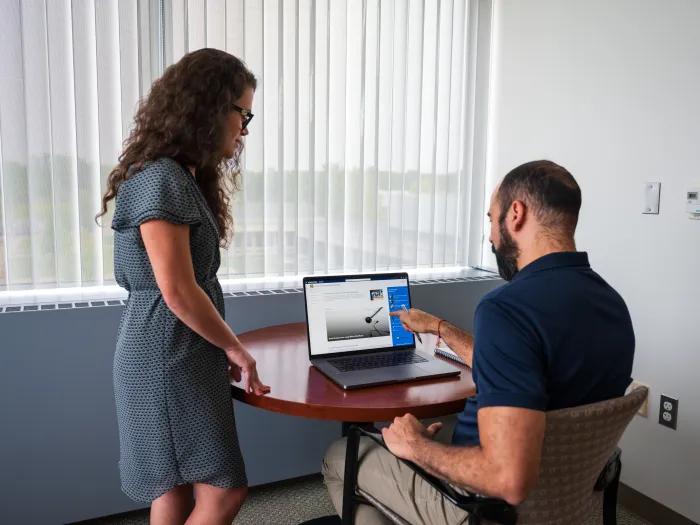
If your data needs are too complex for our self-serve tools, our experienced programmers can pull a custom data set for you – to be delivered once, or on a scheduled, ongoing basis.

Consultations & Training
Do you need help with a custom data pull or need guidance on security guidelines for your data? Schedule a 1:1 consultation to look at all your clinical data needs, where a data specialist offers a deeper dive into the patient health data resources available.

Data & Biospecimen Sharing
Learn more about privacy-sharing policies and related resources. Do you need samples for your research? The Central Biorepository can help.
References and Resources
AI & Digital Health Innovation Analytics Platform Documentation Site – This site contains user guides, data dictionaries, and other tools and resources to get U-M researchers started with using the AI & Digital Health Innovation Analytics Platform to facilitate their research.
DataDirect User Guide – The DataDirect User Guide includes step-by-step instructions, screenshots, and resources for completing frequently-used tasks. Please note that as DataDirect evolves, concepts presented in the User Guide will remain accurate, but the screenshots may vary slightly within the DataDirect tool.
Data Diary Series
A monthly series offered by the Data Office, highlighting data usage tips, tricks, and best practices.
When considering the sharing of data and biospecimens, U-M policy reinforces that data and biospecimens should be collected under transparent informed consent that permits and promotes the maximal use and value of the data and biospecimens consistent with the permissions of the donors.
NOT IN SCOPE
- Transfer of patient-level data and/or biospecimens to governmental agencies, other academic medical centers, universities
- Transfer of aggregate counts or summary level data to commercial entities
- Sharing of data for purposes of patient care
- Transfer of data for purposes of clinical trial* site activity.
*To be considered a clinical trial, the study must meet the NIH definition of a clinical trial.
IN SCOPE and requires review by the Medical School Human Data and Biospecimen Release Committee:
- Transfer of patient-level data (including de-identified) and/or biospecimens to a for-profit or commercial entity, non-academic foundation, or professional society.
- View the policy (login required): https://az.research.umich.edu/medschool/policies/u-m-medical-school-procedures-governing-human-data-biospecimen-transfers-industry
How to Have the Study Reviewed:
- Complete the checklist form: https://az.research.umich.edu/medschool/templates/data-biospecimen-sharing-checklist?pk_vid=57428bcb9677a8471791306548aa0d64
- Send the checklist to [email protected]
- You may not be able to complete all sections of the checklist if in early stages of study planning. Provide as much detail as you can, including a detailed description of the project in the Transfer Overview section, a clear description of the data to be sent (is it coded? limited data set?), and the draft budget.
- Depending on the proposed sharing, the Data Office may review the project on behalf of the Committee, or facilitate review of the proposed project by the Human Data and Biospecimen Release Committee.
- Timeframe: The Committee meets every other Thursday. The time required for review and approval depends largely on receipt of a clear scope of work, including the expected deliverables of both parties.
- The Data Office coordinates with Business Development, Innovation Partnerships, IRB, and ORSP to facilitate approval and contract execution.
Each Fall, many student researchers return to campus to participate in programs such as UROP or pursue independent research projects. Many of these opportunities involve clinical research that uses patient health data to address important research questions.
The Data Office supports meaningful student learning experiences while ensuring compliance with data security and patient privacy requirements. Learn more about the available options for student access to patient data below.
What are the options for student access to Patient Data?
MiChart: While MiChart provides access to patient health data, student access to this particular resource should be considered only when the data variables of interest cannot be found using other data tools.
Self-Serve Tools: The self-serve data tools, Data Direct and EMERSE, provide access to data found in MiChart, including clinical data on more than four million unique patients from Michigan Medicine. The self-serve tools also allow researchers to collect and assemble datasets more easily, rather than combing through MiChart, and include unique features, such as recruitment tools, that may benefit your research needs.
How do I request access for my student, and what type of access is most appropriate?
Please contact our office for a consultation. The consultation will include a review of the data needs for the research project, as well as the student’s role, to determine the most appropriate platform for access to patient data. A tutorial on self-serve tools will also be included if it is determined that the tools will provide the data needed. Let our team support your student’s success.
Clinical data can be a powerful resource for answering research questions, but obtaining the right data requires planning and collaboration. For investigators who are new to working with clinical data as well as those with experience, a few simple steps can help ensure a smoother experience and a more successful project. Our goal is to help investigators obtain high-quality data that supports meaningful research.
Engage Early
One of the most important recommendations is to contact our office early in the research planning process—ideally before submitting your IRB application. Early discussions allow us to assess the feasibility of your project, identify potential challenges, and determine whether the data needed to answer your research questions are available.
Our team can also provide guidance on completing sections of the IRB application related to data requests, helping to reduce delays later in the process.
Consider Data Availability
Not all data elements are available for all patients or across all time periods. Before finalizing your study design, it is important to verify that the information you need exists in the clinical systems and that it spans the timeframe required for your project.
A quick feasibility consultation can help answer questions such as:
- Are the data elements available?
- How far back do the data go?
- Are there limitations in how the data were collected or documented?
- Is the expected cohort size sufficient for the study?
Addressing these questions early can save significant time and effort.
Allow Time for Approvals and Data Preparation
Many investigators underestimate the amount of work required before data can be delivered. Once a request is submitted, it moves through several stages, including regulatory review, clarification of specifications, budget approvals, data preparation, quality review, and final delivery.
Each step is important to ensure that data are accurate, compliant, and aligned with the approved research protocol. Turnaround times can vary depending on project complexity, approval requirements, and the volume of requests being processed.
Because of the high demand for data services, expedited or last-minute requests are generally not possible. Investigators are encouraged to build adequate time into their project timelines and to engage with our office as early as possible.
The Data Office has supported Michigan Medicine’s participation in several national registries, including the Cerebral Palsy Research Network Registry and the United States Immunodeficiency Network Registry:
- Cerebral Palsy Research Network Registry: https://cprn.org/research/cerebral-palsy-registry/
- United States Immunodeficiency Network Registry: https://usidnet.org/registry-data/
Please reach out to discuss registry opportunities for your patients and find out more about how our team of Data Professionals can assist you (Not sure where to start? Contact the Data Office).
Our services include:
- Collaborating with Michigan Medicine research teams, registry networks, and registry data coordinating centers
- Mapping Michigan Medicine EHR data elements to the PCORnet Common Data Model and registry-defined data elements
- Customizing registry-provided reference scripts to meet Michigan Medicine’s technical and operational needs
- Extracting relevant clinical, molecular, and laboratory data from the EHR according to registry specifications
- De-identifying protected health information, including PHI contained in free-text fields
- Performing data quality reviews to promote data validity, reliability, and completeness
- Validating data outputs to ensure high-quality, standardized data capture
- Securely submitting finalized data to registry data centers to support the development of accessible patient databases and advance research
Institutional, home-grown self-service tools are free of charge and support different types of data needs, depending on your study methods.
Use DataDirect when you need to define a patient cohort using structured data (such as diagnoses, procedures, dates of surgery, labs, demographics), estimate feasibility, download a dataset, or explore available data elements for patients included in your cohort.
Use EMERSE when you need to search within clinical notes to find detailed information that is not captured in structured data, such as symptoms, clinical context, or physician observations within free text documentation.
DataDirect helps you identify which patients meet your broad criteria and explore their structured data, while EMERSE helps you understand what is documented about those patients in the clinical notes.
- Have feedback? Complete our brief Data Office survey if you haven’t already.
- Not sure where to start? Simply use this link to create a ticket request with our office. We are committed to providing tailored training/consultation to support your access to the data you need to be successful in your research objectives.
In the world of research data, quality matters. In addition to technical backgrounds, the team in the UMMS Data Office offers strong clinical backgrounds in patient care, too. Data Office informationists collaborate with analysts to ensure that custom data pulls deliver high-quality results, and they can also answer questions regarding data found in MiChart and Data Direct, the self-serve tool. With a deep knowledge of Michart and Data Direct, Data Office staff are a valuable resource to answer questions like:
- Are you struggling to identify if and where a variable you need from MiChart is located in DataDirect?
- Do you know what data variable you’re interested in, but are not sure how to find it in MiChart?
- Do the clinical data you need live in more than one place in MiChart and/or DataDirect?
- Is your output from DataDirect different than what you expected (for example, patients are not there or data seems to be missing from your cohort)?
The Data Office team can act as guides and provide answers to questions like these, allowing you to move forward with your research with confidence that you have the data needed to answer your research questions.
Would you like to meet with a Data Office team member? Create a ticket request.
Data Office At A Glance
How DataDirect is Helping Predict Cardiovascular Disease Outcomes
Contact Us
University of Michigan Medical School
Ann Arbor, Michigan
About Us
The Data Office for Clinical & Translational Research, a unit of the Medical School Office of Research, fosters the translation of data into research that improves clinical outcomes by bridging the gap between personal health data and clinical research.
Upcoming Research Events
Write Winning NIH R01 Grant Proposals

Basic Microscopy Talk Series

Benchtop Demo Day

BRCF Metabolomics Core Microbiome Symposium 2026

Innovations in Omics: Advancing Discovery Through Multiomics

Basic Microscopy Talk Series
10x Genomics Office Hours

Cryopreservation and Assisted Reproduction: Cost-effective methods for model management & sharing
Spatial Multiomics Seminar

Featured Research News

BRCF Holiday Closures

Reinvest Your Core’s Rent Budget with the Recharge Core Support Plan (RCSP)