
Grants Resources & Education
The Grant Services & Analysis Office curated the following information.
For Faculty
- This video offers a brief overview of some of the services and resources available through the UMMS Office of Research or across campus to support your research
- Faculty Resource Guide - A quick reference of resources provided by UMMS Office of Research
- Research Project Route Map - An interactive resource map to help you navigate your own project route on a path to successful research
This video provides a brief overview of the limited submissions competition process for biomedically focused competitions managed by the UMMS Office of Research.
This video provides an overview of the UMMS Biomedical Research Council (BMRC). The Council assists biomedical research and facilitates interdisciplinary research and training through its management of limited submissions competitions and the UMMS bridging support program. Funds are available to established, eligible investigators, allowing them to address NIH/equivalent grant critiques in preparation for resubmission.
The AWARD series is a monthly publication that provides resources and guidance on grant development, academic writing, and research topics.
Large-scale proposal submissions require significant planning and development. Please refer to the following links for resources to assist with Large Team Grant (LTG) submissions:
- A SharePoint resource toolkit with tailored resources and templates for leading and submitting an LTG
- A video describing resources in the SharePoint toolkit, as well as LTG project management services, to assist UMMS faculty and support staff with large-scale proposal submissions
- Additional large-scale proposal resources
- Review examples of successfully funded grant proposals and other resources for NIH, federal, and foundation awards:
- Medical School Grant Proposal Sampler (level-2 password required)
- NIH Data Management and Sharing Plans
- Video overview of the Proposal Sampler
Starting October 1, 2025 (FY2026), NIH will no longer publish funding announcements in their NIH Guide or their NIH Guide Table of Contents subscriptions emails, per NOT-OD-25-143. Faculty and staff should use other tools to be notified of forecasted and active NIH funding opportunities. Please refer to the following resources for guidance on which tool(s) to use:
- Guidance comparing Grants.gov, Simpler.Grants.gov, and Pivot funding search tools
- U-M Library Research Funding and Grants Guide
- Tailored Research Funding Search Consultations through the U-M Library
Effective January 25, 2026, Common Forms for Biographical Sketch and Current and Pending (Other) Support and NIH Biographical Sketch Supplement forms must be used and prepared using Science Experts Network Curriculum Vitae (SciENcv). Please refer to the following resources to assist with these changes:
- A One-Pager document that summarizes the upcoming changes and what researchers can do to prepare.
- A Guide for Adding Delegates in SciENcv to Help Researchers Create and Manage NIH Biosketches and Other Support Documents
- A video overview of the new NIH Biographical Sketch Common Form and Supplement Form that must be made in SciENcv and included in NIH Applications starting on January 25, 2026.
- A video describing how to use the NIH Biographical Sketch Common Form and Supplement to enhance the competitiveness of your application.
- A sample NIH Biographical Sketch Common Form and Supplement to demonstrate format, structure, and typical content.
Preparing an NIH Human Subjects section? Check out these resources:
Video introducing Human Subjects Research
The purpose of a Chalk Talk is to obtain feedback from colleagues on your research aims and objectives early in the grant development process. This document summarizes best practices for holding an effective Chalk Talk to help refine and enhance your Specific Aims before developing an entire grant proposal.
This video provides an overview of cooperative agreements, spnosor expectations - especially NIH, and what to anticipate if you receive an award.
This video familiarizes faculty and staff with key cost principles that shape budgeting and spending on sponsored projects. Its goal is to help faculty understand how these principles apply to proposing and managing expenditures.
This video explains the distinction between direct and indirect costs in sponsored research, providing practical examples. It aims to enhance understanding of how both types of costs play a vital role in sustaining and supporting research.
This video provides an overview of procurement considerations and requirements when using extramural funding. Learn best practices by reviewing the steps in the procurement lifecycle to avoid purchasing pitfalls.
This video provides an overview of childcare costs available to NIH NRSA supported fellows and information on accessing the funds at the University of Michigan and may be useful to faculty mentoring NRSA fellows.
Program Officers (POs) implement and manage science and public health programs. The following is an adaptable email template for contacting a PO.
Many federal agencies recommend emailing a PO with a Biosketch and a PDF draft of a One-Pager/Summary. A concise One-Pager is a great way to quickly "pitch” the key components of a proposal and can later provide a strong basis from which to build a full project description.
The GS&A has developed guidelines for U-M faculty writing a One-Pager/Summary as well as One-Pager Considerations.
The GS&A office is happy to provide feedback on drafts before sharing with a PO. Please email [email protected] for inquiries.
Document Library
- Grants Processing Policy - Our policy detailing the grant processing deadlines.
- Grant Services & Analysis Service Policy on Submitting PHS Proposals - Our policy on submitting PHS system-to-system electronic proposals.
- Clinical Trial Routing Form (CTRF) - This page explains the required use of the CTRF within the Medical School.
- Effort Reporting - This link takes you to the UMHS site that houses the effort reporting policy. The policy details how Medical School and UMHS faculty and staff report time and effort.
- Establishing Subaccounts - This policy describes when a subaccount should be expected and provided.
- Institutional Cost Sharing - This policy describes the process and conditions for obtaining a research cost share commitment from the Medical School Dean's Office, HHC, or EVPMA. Further, this also addresses the process for Medical School units seeking a cost share from the Office of the Vice President for Research (OVPR).
- Indirect Cost Recovery Policy - This policy describes the Medical School's expectations regarding recovery of indirect costs.
- Indirect Cost Waivers - This policy describes the process that should be followed by Medical School units seeking an indirect cost waiver.
- Indirect Cost Waivers on Federal Patient Pass-Through Costs - This policy describes the process and conditions for Medical School units seeking a reduction of indirect costs on pass-through expenses related to clinical trial patient payments.
- Recovering Full Indirects: Industry Funded Research - This policy describes the required process that should be used to negotiate the indirect cost rate with industry sponsors.
Budget Templates - This page contains budget templates in several formats that can be used to prepare research proposal budgets, as well as some templates to assist with calculating salary over the PHS cap and working with UM/VA split appointments.
Handling Recharge Service Units in Grant Proposals - This document describes how recharge service units should be reflected in grant proposals.
- Canceling a PAF - This best practice explains when it is advised a PAF be canceled, how to do it, and who is able to complete the activity.
- Changes After Routing in eRPM - This best practice describes the procedure that should be followed when changes are made in eRPM after a proposal has been routed.
- Counting Pages - This best practice details a quick and easy method for ensuring you are not over the allowed page limit.
- Leaving Comments in eRPM - This best practice describes how comments that are left in eRPM need to be concise but thorough for all potential viewers.
- Ready to Finalize? - Creating the Final PDF (Grants.gov) - This best practice explains the process of creating and reviewing the 'final' PDF prior to finalizing or submitting a NIH proposal.
- Review of Proposals in the Commons - This page clarifies the NIH 2-day window following proposal submission and the ability to reject / resubmit a proposal.
For Administrators
In addition to the training resources below, you may also wish to visit the NCURA channel on YouTube for "YouTube Tuesdays," where you'll find more short, helpful videos on many aspects of research administration. But as you watch videos, remember that Michigan's institutional policy may differ from the presenter's and any question about applicability in our context may be directed to the Grant Services & Analysis at [email protected].
Going for the Perfectly Routed Proposal: The Grants Office's Top 10
These resources hold the presentation materials from the training session held in April 2013. The session highlighted the most common problems (and solutions!) that the Medical School Grants Office comes across during administrative review, things to keep in mind when putting a proposal together, and some best practices. Attendees left with a better understanding of what happens during the Grants Office review and how to prevent common issues. The session was geared towards all experience levels, from the newest hire to the seasoned research administrator.
- The Perfectly Routed Proposal - The PDF of the PowerPoint presentation from the session.
- Frequently Required Proposal Information - A link to the standard information that is needed for Face/Cover Pages when preparing proposals, provided by ORSP.
- FCOI Disclosures for Proposals - The campus FAQ site provides detailed information about the Financial Conflict of Interest (FCOI) regulations.
- Checklist for Routing the Administrative Shell - This page presents the items that are reviewed by the Medical School when an Administrative Shell is routed for review and approval.
- Comments in eRPM - This best practice describes how comments that are left in eRPM need to be concise but thorough for all potential viewers.
- Counting Pages - This best practice details a quick and easy method for ensuring you are not over the allowed page limit.
- Administrative Shell Changes After Routing - This document describes the procedure that should be followed when changes are made in eRPM after a proposal has been routed.
- Proposal Finalization Checklist - This checklist provides you with key items to check before finalizing a proposal (reflective of issues commonly found prior to submission).
- Ready to Finalize? - This best practice explains the process of creating and reviewing the 'final' PDF prior to finalizing or submitting a NIH proposal.
- Service Policy on Submitting PHS Proposals - Our service policy on submitting PHS system-to-system electronic proposals.
- Review of Proposals in Commons - This document clarifies the NIH 2-day window following proposal submission and ability to reject / resubmit a proposal.
The Administrative Shell of the NIH Research Grant
This page contains the presentation materials from the training session held in May 2013. This session walked through the common information and expectations of putting together the administrative shell pages for an NIH research grant application (R01, or similar) -- covering issues from the first question of Application Type on the cover page to the Multiple PI Plan on the last, and almost everything in between. A significant portion of the time was spent on budget/justification rules and institutional expectations, as well as highlighting the last things you should double check before saying "Submit!"
- The Administrative Shell of a NIH Research Grant - The PDF of the PowerPoint Presentation from the session.
- Sample SF424 Application - A PDF of the SF424 application (administrative shell components).
- Biosketch - Guidance on how to prepare a biosketch.
- Sample Biosketch - A link to the Sample Biosketch provided by the NIH in Word format.
- Differences Between the Biosketch and Other Support - A link to the Grant Services & Analysis webpage that describes the differences between the two documents.
- Budget Justification - Guidance, by budget type, on preparing the budget justification.
- Consortium/Contractual Arrangements - Guidance on what to obtain when including subcontract sites in an application.
- Letter of Commitment to Establish a Subcontract Agreement - A link to the form that should be filled out by the subcontract sites when preparing an application. This form includes the required FCOI questions.
- Facilities & Other Resources - Guidance on what to include in the Facilities & Other Resources document.
- Multiple PI Leadership Plan - Guidance on what to include in the Multiple PI Leadership Plan
- NIH SF424 Application Instructions - A link to the SF424 Application Instructions provided by the NIH.
Budgeting a Clinical Trial - A PDF of slides from a 2012 training session on how to budget a clinical trial.
This video explains the distinction between direct and indirect costs in sponsored research, providing practical examples. It aims to enhance understanding of how both types of costs play a vital role in sustaining and supporting research.
This video familiarizes faculty and staff with key cost principles that shape budgeting and spending on sponsored projects. Its goal is to help faculty understand how these principles apply to proposing and managing expenditures.
Communication & Response Times with ORSP
The Medical School has been asked to provide guidance for best communicating with ORSP, as it may be needed in order to support the research endeavors of our faculty as effectively as possible. ORSP has published information about their target response time goals and handling of various requests. This “Communications & Response Time with ORSP” document provides additional information from the Grant Services & Analysis Office in order to outline how to best contact ORSP, when to follow up, and, if needed, how to escalate issues. These same steps, especially requesting and documenting in the system, may be used with any of the central offices that complete work in eRPM.
Remember that RAAC Communications helped put together a Best Practices document that you should review and have familiarity!
Project Team Request ORSP Action: Use this activity to place requests into ORSP whenever possible on an existing file. This will place work in their system work queue. Emails, Posted Comments, and even phone calls may not be seen.
Post a Comment: Use this for documenting communication with ORSP in the eRPM system. If you leave voice messages or send side emails (though not recommended!), project teams have the option to in the eRPM system and check the box to send the communication to No One. Doing this will easily show the history of contacts attempted over time. We recommend posting in real time to No One if you leave a telephone message, send an email, etc. Including a snippet of the subject and an update on the issue with each posted comment. This is the best, and possibly only, way that the Medical School will be effective in helping resolve lagging situations.
In general, the Medical School promotes the approach of “half the distance to the goal” for updates and follow-up. For example, if ORSP is striving for a 10 business day turnaround, asking for an update at intervals after that time expires and the subsequent 5 and 3 business days is appropriate. In the chart below (Blue Example), a PAF arrives at ORSP with a contract for redline on Day 1, requesting an update (if needed) on business days 11, 16, and 19 is appropriate. Likewise (Green Example), if there is a Request ORSP Action which has a target completion of 3 business days, following up on business day 4, 6, and 8 seems reasonable.
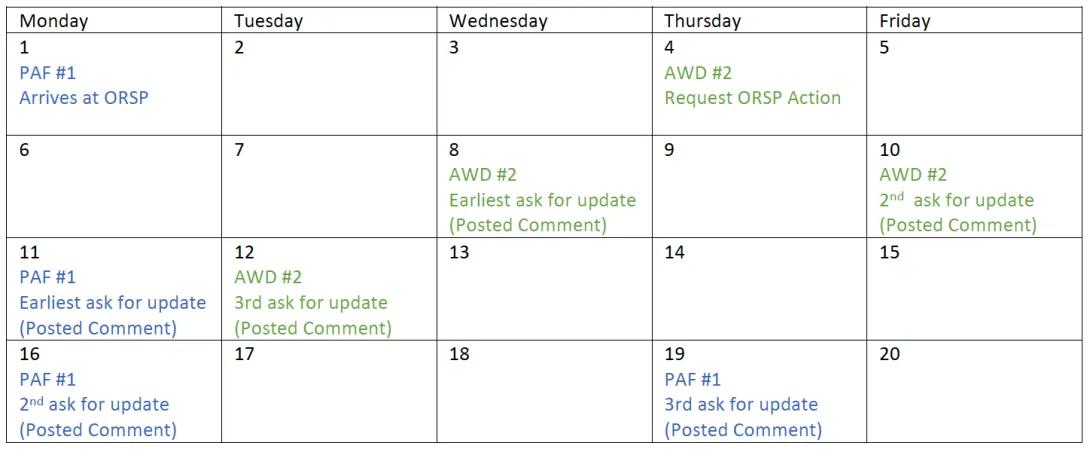
Recommended Escalations for Update Requests that have NO response:
- Earliest Ask – Include PR and Support Staff
- 2nd Ask – Include PR and Support Staff, your department lead research administrator, and the PR Assistant Managing PR
- 3rd Ask – Include PR and Support Staff, your department lead research administrator, the Medical School (msgrants), and the PR Assistant Managing PR and Managing Project Rep
Asking the Medical School to Intervene: At the point you have exhausted the process above and would like the Medical School to intervene on your behalf, please be sure that the notes posted to the eRPM system are very clear, contain summarizing information, and were followed to the letter. Then contact us with a specific note asking us to intervene (you can do in eRPM if you check MSGrants as a recipient or send an email directly to MSGrants), it can be done right after the 3rd ask.
Helpful Hints
- Review the eRPM record to be sure that all attempts have been documented. It should be clear to anyone receiving the issue what the previous contact has been, without needing additional side information.
- Follow the stated ORSP request that you share the impact on the project if there is a lack of completion or response as of the third attempt to connect.
- Be reasonable! Not everything will make it all the time. Be sure that the ones that are important are the ones requested to be escalated. Likewise, know that the Medical School can’t escalate everything, and we also have to pick and choose among priorities....
- As a friendly reminder, “updates” do not mean that the issue will be fully resolved. Open dialogue to understand challenges with executing the request may be necessary. This follow-up and escalation schedule is most appropriate to set expectations about communication on the project.
- Share your experience – this is not something that can be tracked or measured in the system.
Phone Calls
Although connecting by phone is sometimes challenging, this is still a viable option. (Again, recommended to document messages left through Post A Comment to No One!). ORSP has indicated that even though remote, they are picking up their phone messages. If something is extremely time sensitive and you need to reach someone by phone, remember that the general ORSP contact phone number is available: 734-764-5500
A Basic Definition of Cost Sharing - A quick description of the institutional investment created when full costs are not requested or recovered by the sponsor.
The Difference Between Tracked (Quantified) and Not (Non-Quantified) Cost Sharing - Not all institutional investment (cost sharing) must be tracked. This video explains the difference in terms of what is represented to the sponsor.
Effort - Navigate Lunch and Learn - ORSP's Navigate: Lunch & Learn session from February 2018 covering effort reporting and certification. Faculty and staff are responsible for monitoring their activities to ensure that their effort is supported by fund sources appropriate to their activities, and for certifying their effort on an annual basis. But effort reporting and certification can be a confusing topic for faculty and research administrators alike. In this Lunch & Learn session, Heather Offhaus, Director of the Medical School Grants Review & Analysis Office, provided a basic overview of Effort and discussed its importance.
Effort Part 1 - The Three Mantras of Effort Reporting - An introduction to the basics of understanding effort & effort reporting. Three simple rules to why and when you track what.
Effort Part 2 - Talking with Faculty About Effort - Tips on discussing effort with those that must report and certify their effort.
The Intergovernmental Personnel Act (IPA) Mobility Program allows temporary work assignment of employees between UM and federal agencies by executing an IPA Assignment Agreement. The employee on assignment remains an employee of and continues to be paid by their respective employer for the duration of the time they are on the temporary work assignment. Reimbursement for employee expenses are negotiated between the two parties but at a minimum typically include salary and fringe benefits. For more guidance, visit Intergovernmental Personnel Act (IPA) Assignment Agreement Guidance.
The process of transferring grants between institutions can be difficult. Not only does the PI have preferences to express, but the institutions involved have to agree. And once the decision to transfer (or not!) is made, each individual grant may have different requirements, even when dealing with the same sponsor. It is important to communicate among all the “interested parties” – PI, institution, the funding agency’s Program Officer and Grants Management Specialist (or equivalents) – to ensure a timely and efficient process.
Considerations related to the process:
- Transfers may involve many parties, such as the PI, Research Administrator, Department Chair and/or Administrator, Dean’s Office, University Central Offices (ORSP, OTT), Sponsor’s Program Officer and Grants Management Specialist, and the other institution.
- The original grantee institution must be willing to transfer the grant to the new institution – grants are awarded to the institution, not the PI. As a result, before transferring a grant out of an institution the PI and/or Research Administrator will need to discuss their wishes with the Department Chair and/or Dean’s Office.
- The sponsor has the right to refuse the request coming from the institution.
- Forms and information required to transfer grants may change from one grant to another. Always contact the Program Officer and Grants Management Specialist each time for up-to-date instructions.
- When in the process of transferring grants into UM, consider requesting a Hardship Account. Transfers often take some time to process and establishing an account will allow appropriate charges to be associated with the P/G until the award arrives – saving time later!
- When transferring grants out of the UM, equipment, personnel, and other research-related items, for example lab notebooks, data sets, or intellectual property, may need to be specifically reviewed and authorized for transfer out as well. Please see the resources below for more information.
Resources
- Presentation (November 2014) on Transferring Grants between Institutions.
- RASC website - Best practice document on transfer of institution general considerations.
- Medical School's Post-Award Best Practices related to post award close out of transfer projects.
- UMMS Office of Research's Managing a Research Operation page.
- ORSP provided checklists for US Army Medical and NSF.
The video addresses why you might consider using advance (aka Hardship) accounts and the risk associated with them.
This video is a quick reminder about the importance of maintaining proper documentation.
Navigate: E-ssentials eLearning Modules - A collection of self-paced elearning modules covering a variety of topics related to research administration at U-M. Addressing common tasks, concepts, and business processes encountered throughout the Sponsored Project Lifecycle, Navigate: E-ssentials also provides resources and job aids to assist research administrators with the successful management of a sponsored project.
Office of Research Training Opportunities - Other units within the Medical School's Office of Research often provide training sessions on various topics. This link will provide information on other those opportunities.
Campus Training Opportunities - The Office of Research and Sponsored Projects (ORSP) on campus also offers training sessions on a variety of topics.
This video provides on overview of university supported tools and resources available to research administrators for managing Financial Status Reports (FSRs).
This video provides on overview of university supported tools and resources available to research administrators for Troubleshooting Closeouts (PG Inactivation).
If your proposal or award involves hospital participation, please contact “[email protected].”
If you’re interested in learning more about resources available to support hospital units with grants and sponsored projects, please watch this YouTube introduction to Hospital Grant Support Services (https://www.youtube.com/watch?v=dYmBwjJnRYo&t=10s).
Networking & Current Training Opportunities
Are you seeking a forum where you can share knowledge, build ‘RAPPoRT’ with & learn from other Michigan Medicine Research Administrators?
The RAPPoRT Discussion Group is an opportunity for Research Administrators to network, build collaborations with colleagues, and engage in discussion on pre & post-award research topics. No registration is required to attend. Discussion groups are held virtually, are informal, and attendees are welcome to bring their lunch.
Need additional time to talk or have a question on another research topic?
Open Door RAPPoRT, hosted by Jane Sierra & Brooke Dougherty Reyes immediately following the group discussion, offers pre & post-award administrators a one-on-one opportunity for additional discussion on any pre or post-award topic with either Jane or Brooke.
RAPPoRT Discussion Group & Open Door Series
(Research Admin Pre & Post Research Topics)
Schedule: First Monday of the month (*exceptions noted below)
12:00 PM – 1:00 PM: RAPPoRT Discussion Group
1:00 PM – 2:00 PM: Open Door RAPPoRT
Meeting announcements are sent to the Research Administrators – Michigan Medicine email group. Requests to join can be sent to [email protected].
* No January Meeting / September meeting held on the first Tuesday due to the holiday
The Pre-Award Proposal Guide provides an overview of Medical School Grant Services & Analysis requirements on a PAF and within a proposal. Information in the guide contains guidance on budgets, various types of agreements, and common situations, as well as sponsor-specific tips. This tool will be helpful for both brand-new and seasoned research administrators and is written with the assumption the reader has basic knowledge of eRPM.
The Post-Award Procedures Manual represents the consolidation of the Medical School post-award procedures and best practices. It is designed to serve the sponsored project post-award community, is based on utilizing Real-Time Financials modules, and is written with the assumption that the reader has a basic knowledge of post-award policies and University procedures.
Onboarding and Introduction to Resources You Should Know
The Grant Services & Analysis office recognizes Research Administration training resources and tools are not always easy to find. To help transition to research administration in Michigan Medicine, we’ve mapped topic-specific information in pre- and post-award, as well as types of access you might need and professional development opportunities. Don’t see what you need below? Email [email protected] for help!
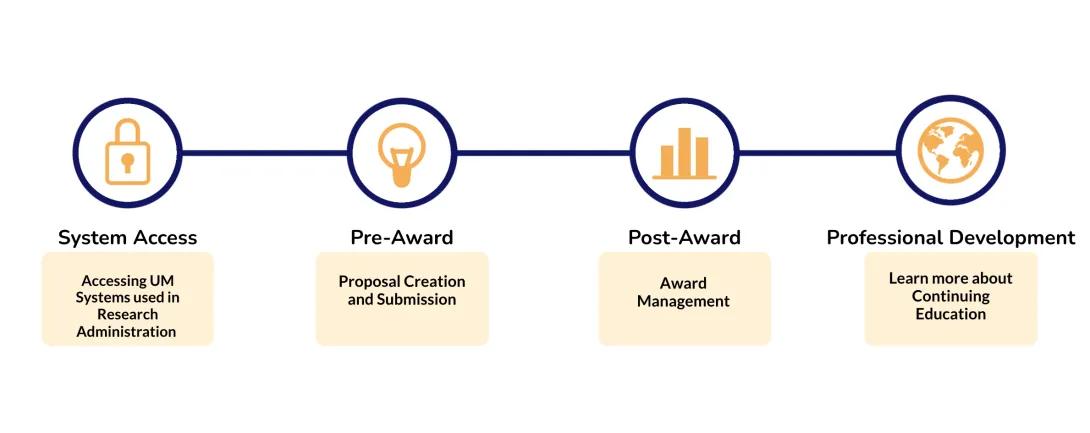
Pre-Award
Pre-Award supports the creation and submission of a proposal. This includes partnering with investigators to review funding opportunities, determine budgetary needs, complete sponsor forms, and route proposals in eRPM for review, approval, and submission of the application. The resources below provide learning opportunities about different items that Research Administrators may assist Investigators with throughout proposal creation.
Post-Award Management
Post-Award Management occurs over the duration of an award and includes award & account setup, as well as partnering with investigators in monitoring fiscal activity, managing changes to the initial award (modifications), reporting progress, and completing closeout requirements. The resources below provide learning opportunities about different items that Research Administrators may assist Investigators with throughout an awards' lifecycle.
Post-Award Onboarding Guide
This document provides essential resources and allows individuals to navigate through onboarding in an asynchronous environment. Topics include a worksheet which simulates the review of a project grant, an integrated checklist to monitor completion of key tasks, and many resources which are essential to any new research administrator.
Extra Worksheet
Simulates review of a project grant
Professional Development
Professional Development and career training provides the opportunity to learn and apply new knowledge and skills that can help you in your job and further your career. The resources below provide learning opportunities to support growth in both the knowledge and skills required in Research Administration.
System Access
System Access regulates what data a user can access and what transactional activities they can view or perform. The following provides information about accessing systems commonly utilized in Research Administration.
Post-Award Quick Video Series
Watch the video, or visit the Post-Award Manual.
Watch the video, or visit the Post-Award Manual.
Watch the video.
Disclosure of Other Support
NIH and other federal agencies have recently implemented more expansive requirements for disclosing other support and foreign affiliations. These instructions have increased what U-M previously reported - to include agreements outside U-M, in-kind contributions, and copies of agreements with entities outside the US. The revised Other Support format also includes a new attestation statement and the requirement for digital signature. We know that this causes confusion, and perhaps apprehension, among faculty as we learn to navigate these new requirements and share the information with federal agencies. The Medical School has developed tools and resources to supplement campus information to directly aid faculty and staff in remaining compliant.
If you have questions about content or how these rules impact your reporting to U-M or NIH, we encourage you to use the resources below or reach out with your questions to: [email protected]. Need immediate help? Contact [email protected] to schedule a 1-1 discussion about your specific questions.
Disclosure FAQs
Central Campus is keeping an FAQ list through their website.
Contact [email protected] immediately to schedule a 1-1 discussion. Because the discovery may impact multiple projects, a comprehensive plan for disclosure to all sponsors on all projects impacted will be necessary. The team at [email protected] can help navigate and create a plan for you and your team to follow.
External consulting or collaboration agreements (also called personal services agreements) that involve the design, conduct, or reporting of research need to be included as part of Other Support. If the agreement is with a non-US entity, also include the agreement as supporting documentation. If not in English, also provide an English-language copy of the agreement. (Google Translate is fine.)
Examples of consulting work that likely involves the "design, conduct, or reporting of research" include:
- work that may result in publication in an academic journal,
- designing a protocol,
- data analysis,
- serving on a steering committee for a clinical trial
It is sometimes hard to tell, especially if the company is part of a larger organization with home offices in another country. If you are unsure if an outside agreement is with a foreign entity (and therefore would require submission of a copy of the agreement with your Other Support), U-M is advising that you may reference the subsidiary name and/or address listed in your agreement.
Discussion Opportunities
- Advice / Help on interactions with sponsors
- Questions related to applications: Biosketches, Foreign Components, Facilities
- Awards: JIT Materials & RPPRs: Other Support & Supporting documentation
- Previously undisclosed Other Support
Can pose question by email or request a one-on-one consultation.
- General questions about outside interests/potential conflicts of interest & M-Inform disclosures
- Ongoing one-on-one consultations
- Share a more in-depth description of requirements
- Address general questions & concerns
Would you like to request one? [email protected]
Watch the 2/17/22 Medical School Research Town Hall for a brief overview on Other Support.
Or, view the presentation slides.
Contact Us
University of Michigan Medical School
Ann Arbor, Michigan
