About MCDTR

Turning Research Discoveries into Lifesaving Practices
Interested in joining MCDTR?
Specific Aims
- Support new and established investigators in developing, implementing, and evaluating evidence-based approaches to improving care in communities and health care organizations to improve diabetes-related outcomes; (All cores and programs)
- Provide education, training, and exchange to foster interdisciplinary and cross-sectoral collaborations to develop and support early stage and other researchers; (All cores and programs, Enrichment Program)
- Raise awareness of and interest in translational research in diabetes and related conditions with a particular emphasis on novel approaches to improve health outcomes and create an environment that supports such research at UM, regionally, nationally, and internationally; (All cores and programs, Administrative Core)
- Administer a Pilot and Feasibility (P/FS) Grants Program to attract new researchers to diabetes translational research and provide mentorship to enable awardees to generate sufficient preliminary data to successfully apply for research funding from NIH and other national granting agencies; (All cores and programs, Administration Core)
- Support communication, collaboration, and central resources, including web-based resources, for investigators working on T2-T4 diabetes translational research to improve health outcomes; (Administration Core)
- Catalyze cross-sectoral collaborations to develop and evaluate programs and policies to improve health outcomes for people with and at risk for diabetes; (Cross-sectoral Collaborations Program)
- Consult with investigators on study design, protocol development, data acquisition/collection, statistical analysis, implementation, and dissemination of behavioral, clinical, and health systems-related translational research studies; (Evaluation Methods and Intervention Strategies [EMIS] Core)
- Provide support for studies to improve accessibility and effectiveness of care and self-management support using mobile, telephone, and web-based tools; (EMIS Core)
- Support state-of-the-art translational research to measure, screen for, and address socio-ecological, economic, and behavioral determinants of health to ensure fair access to diabetes prevention and treatment; (Social and Behavioral Determinants of Health Core)
- Through its collaboration with the University of North Carolina-Chapel Hill and national Core on Leveraging Community, Family, and Peer Support, promote research in the MCDTR and nationally that leverages varied types and combinations of community, family, and peer support to improve individual and population health.
Administrative Structure
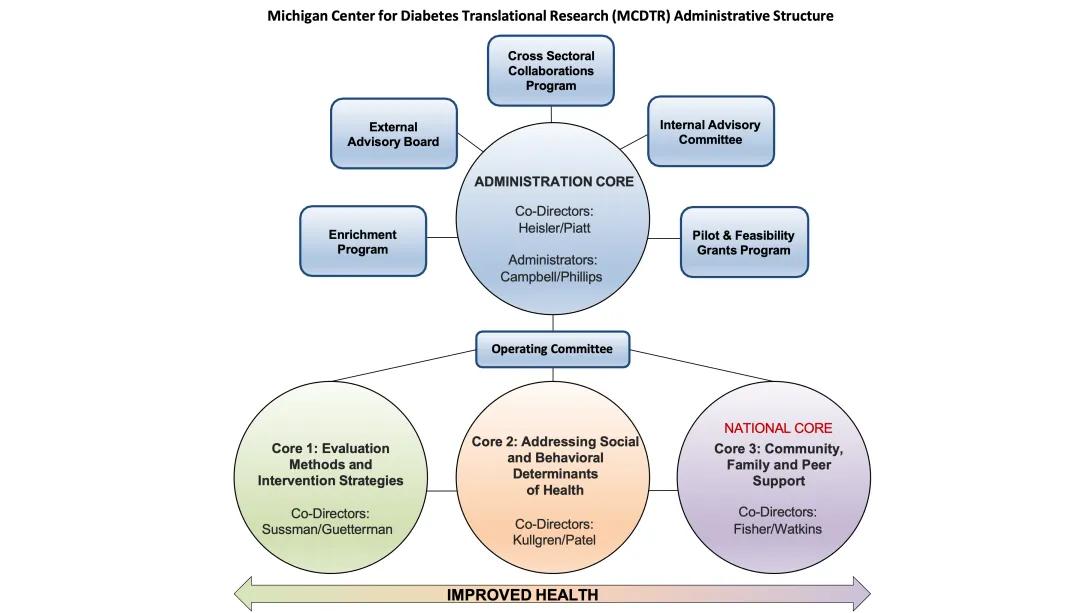
The image illustrates the administrative structure of the Michigan Center for Diabetes Translational Research (MCDTR). At the core of the structure is the "Administration Core," which is directed by Heisler and Piatt with administrators Campbell and Phillips. This core is linked to five components: the "Cross Sectoral Collaborations Program," the "External Advisory Board," the "Enrichment Program," the "Internal Advisory Committee," and the "Pilot & Feasibility Grants Program," displayed around it.
Below the Administration Core is an "Operating Committee," which connects to three distinctive cores vital to the structure's functioning. These are:
1. Core 1: Evaluation Methods and Intervention Strategies (Co-directed by Sussman and Guetterman)
2. Core 2: Addressing Social and Behavioral Determinants of Health (Co-directed by Kullgren and Patel)
3. Core 3 (National Core): Community, Family and Peer Support (Co-directed by Fisher and Watkins)
The overall aim of this organizational structure is to achieve "Improved Health."
Leadership

Michele Heisler, MD, MPA

Gretchen A Piatt, PhD, MPH