
MNORC Cores

Multiple Cores & Programs
Administrative Core
The Administrative Core supports research and services in the five research cores and is responsible for the overall management of the MNORC.
Learn more about the Administrative Core
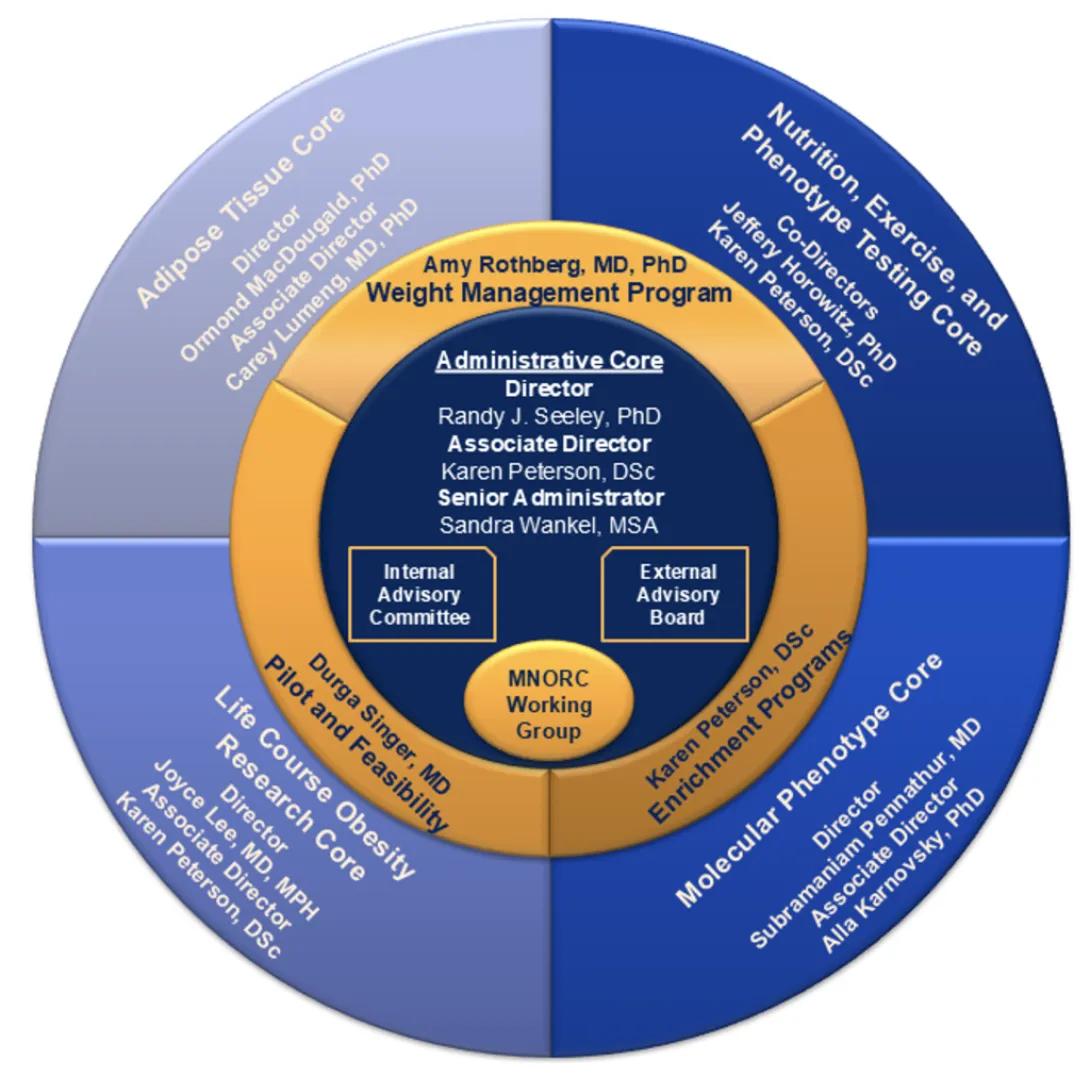
Circular organizational chart for the Michigan Nutrition Obesity Research Center (MNORC).
The central gold circle lists the Administrative Core with Director Randy J. Seeley, PhD; Associate Director Karen Peterson, DSc; and Senior Administrator Sandra Wankel, MSA, along with Internal Advisory Committee, External Advisory Board, and MNORC Working Group.
Surrounding sections represent program areas: Adipose Tissue Core (Ormond MacDougald, PhD; Carey Lumeng, MD, PhD), Life Course Obesity Research Core (Joyce Lee, MD, MPH; Karen Peterson, DSc), Molecular Phenotype Core (Subramaniam Pennathur, MD; Alla Karnovsky, PhD), and Nutrition, Exercise, and Phenotype Testing Core (Jeffrey Horowitz, PhD; Karen Peterson, DSc). The outer ring includes Enrichment Programs and a Weight Management Program directed by Amy Rothberg, MD, PhD. The chart uses gold and blue color gradients.
Nutrition, Exercise and Phenotype Testing (NExT) Core
The NExT is a collaborative network of on-campus laboratory and research facilities that provides expanded support for clinical and translational research studies utilizing nutrition interventions and/or focused on obesity or obesity-related metabolic disorders in humans.
Molecular Phenotyping Core (MPC)
The MPC performs functional metabolic studies in in vitro systems and provides analytical tools that permit structural identification and quantification of metabolites.
Adipose Tissue Core
The University of Michigan Adipose Tissue Core brings together laboratories across campus to research diabetes, obesity, and adipocyte biology.
Weight Management Program
The Weight Management Program is a Demonstration Unit that provides state-of-the-art clinical care for patients with obesity. Patients can opt into a translational research program in which they undergo extensive baseline and interval biological and behavioral phenotyping during weight loss to determine their metabolic and neuropsychosocial phenotypes. Over 1,300 individuals have participated, and 48,000 biological samples are available to investigators interested in nutrition, obesity and metabolism.
If you want to know what samples or data are available or have questions regarding procurement for your studies, go to the Central Biorepository.
Life Course Obesity Research Informatics Core
The Life Course Obesity Research Informatics Core (LORIC) supports basic, clinical, and translational researchers focused on childhood nutrition and obesity and enhances integration of research into the clinical delivery system.
Previously Supported Cores
The IBIC provides support through expertise in experimental design, data management and analysis for preclinical, clinical, and translational research.
The Integrative Biostatistics and Informatics Core will provide expertise in experimental design, data management and analysis for preclinical, clinical and translational research studies conducted by the MNORC Research Base investigators.
To provide these services, the IBIC/MNORC will continue important interactions with the Michigan Institute for Data Science (MIDAS), Center for Computational Medicine and Bioinformatics (CCMB), the National Center for Integrative Biomedical Informatics (NCIBI), the Michigan Institute for Clinical and Health Research (MICHR), the Statistical Analysis of Biomedical and Educational Research (SABER), and the Statistics Online Computational Resource (SOCR) . The Core will support database design for both preclinical and clinical studies. Clinically relevant databases will be Health Insurance Portability and Accountability Act (HIPAA) compliant.
Our services include:
- Expertise in experimental design and modeling for preclinical, clinical and translational research studies that integrate clinical, molecular, neurobehavioral and other phenotype data.
- Support for data acquisition and analysis by the MNORC phenotyping Cores and Investigational Weight Management Clinic.
- Provide expertise in database construction, maintenance and security relevant to investigators studies.
- Provide expertise in bioinformatics and statistical analysis of data and data mining.
- Promote development and use of database and software tools for information organization and visualization of tightly-linked multiscale data for T1 translation of research knowledge relevant to obesity.
- Data, analytics and visualization support for research studies, papers, grants, and collaborations.
Research Facilities
- Data Analytical Protocols: Development, customization, and validation of Big Data harmonization, processing, aggregation and analytics protocols.
- Statistics Online Computational Resource (SOCR): High-end online scientific data visualization services, learning modules, scientific computing resources.
- Distributed Computing: High-throughput distributed computing environment with an intuitive front-end graphical user interface and a powerful back-end compute server.
- Michigan Regional Comprehensive Metabolomics Resource: Resources for improving the diagnosis, prevention and monitoring of many diseases through metabolic profiling. The metabolome is the sum of all metabolites at a given moment. Profiling gives a chemical readout of the state of health of the cell or body and its changes. These results provide a wealth of information about nutrition, infection, health and disease status.
- Consultation: A broad consultation services with deep statistical, mathematical, computational and analytic support for data management, storage, query, retrieval, processing, modeling and interrogating complex and heterogeneous datasets. Coaching and mentoring junior scholars in computational and data science predictive analytics.
Contact Us
Ivo Dinov, PhD
Professor of Computational Medicine and Bioinformatics
Professor of Nursing
734-615-5087
The APC provides infrastructure to perform advanced, standardized metabolic phenotyping of animal models of obesity and metabolic diseases.
