
Anesthesia Simulation Training
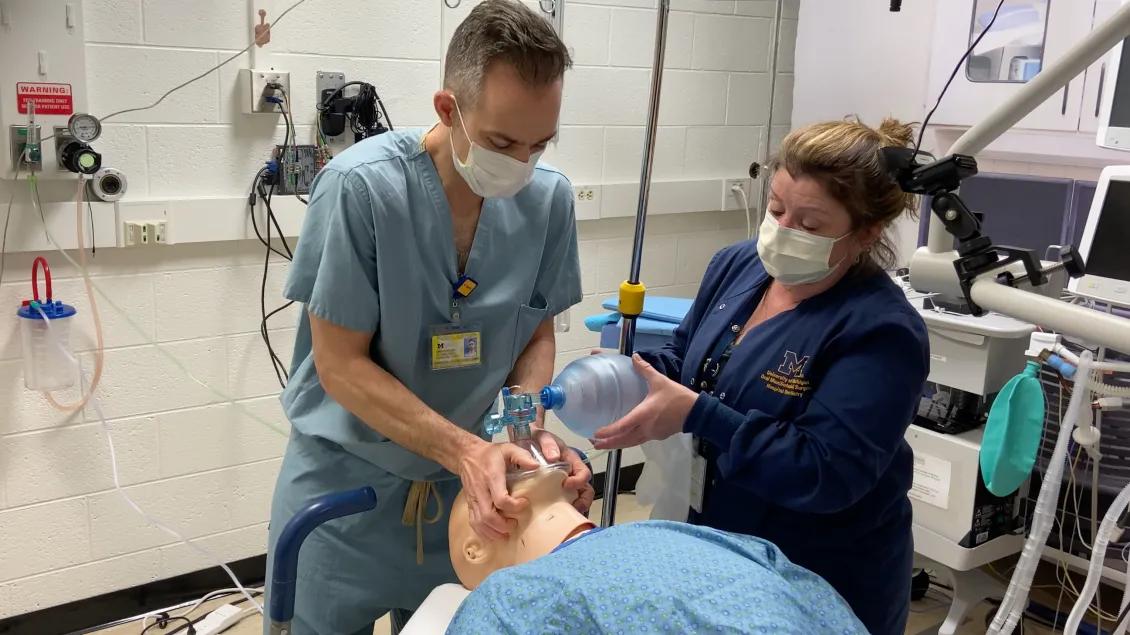
The U-M Medical School Section of Oral and Maxillofacial Surgery and the Clinical Simulation Center offer team-based anesthesia simulation training for oral and maxillofacial surgeons.
The Anesthesia Simulation Training for Oral and Maxillofacial Surgeons (AST-OMS) course is a high-fidelity, immersive experience designed to build muscle memory for your entire surgical team to ensure efficient recognition and management of anesthetic complications.
This course has been endorsed as an equivalent program to the American Association of Oral and Maxillofacial Surgeons (AAOMS) National Simulation Program. Completion of this course fulfills the necessary simulation for AAOMS membership. Verification of compliance of successful anesthesia simulation training will be through the Office Anesthesia Evaluation (OAE) program.
CE credits for this course will be provided by the Chalmers J. Lyons Academy.
For More Information
Learning Objectives
Participants will rotate through three "go live" scenarios. A facilitator acts as the attending to standardize medication dosing, allowing participants to focus strictly on managing various emergencies and anesthetic complications such as:
- Respiratory depression
- Respiratory arrest
- Upper airway obstruction including can’t intubate/can’t ventilate
- Partial and complete laryngospasm
- Lower airway obstruction
- Bronchospasm
- Pulmonary gas exchange abnormalities
- Allergic reactions including anaphylaxis
- Distributive shock
- Cardiac arrest
Specific Skill Competencies
By the end of this course, participants will demonstrate proficiency in:
- Monitoring: Interpreting Capnography (ETCO2) and other indicators of respiration, interpreting heart rate and blood pressure changes, SpO2 waveforms, and recognizing critical alarms (e.g., SpO2 < 90%).
- Airway maneuvers: Head-tilt chin-lift, jaw thrust, Triple-O, Larson’s maneuver, use of oral/nasal airway, one-person and two-person BVM techniques.
- Advanced airway: LMA placement, intubation with standard laryngoscope and video laryngoscopy (AirTraq) and surgical cricothyrotomy.
- Anesthesia Crisis Resource Management (ACRM): Resource mobilization including when to call for help, task delegation, cognitive aid usage, and leadership during emergencies including code situations.
Course Structure
The curriculum is divided into three phases to ensure you are prepared before you enter the simulation suite. We utilize the SimMan® 3G, a state-of-the-art simulator capable of exhibiting a range of normal and abnormal physiological states such as:
Airway: Tongue and pharyngeal edema, trismus (lockjaw), and laryngospasm.
Breathing: Wheezing, rales, stridor, and varying pulmonary compliance/resistance.
Circulation: Palpable pulses (Carotid, femoral, radial) and realistic EKG rhythms.
- Intervention: Allows for IV access, defibrillation, cricothyrotomy, and intubation.
Course Phases
Participants will be able to access lectures, decision trees and demo videos that cover topics like:
- Risk stratification
- Airway algorithms
- Medications
Guided practice on the SimMan® 3G including:
- A to Z airway management approaches
- Team communication and dynamics
- Management of common and rare emergencies
- Review pre-anesthetic and peri-operative considerations for case selection.
- Team management of three standardized, high-stakes anesthesia emergencies while performing an intra-oral procedure.
- Practice rapid assessment and interventions while leading a surgical team with effective communication strategies, delegating tasks and preparing for next steps.
- Team performance debriefs after each scenario.
Course Registration
Interested in taking the course? Please fill out this interest form.
Capacity: Sessions are designed for 1-2 practicing oral and maxillofacial surgeons (each provider must register separately) and 4 staff members per provider.
Cost: $2500
Cancellations: Cancellations must be emailed to course coordinator, Marina Zupelari ([email protected]).
Location
Dept. of Medical Education, Towsley G1100
Ann Arbor, MI 48109-0201
