Geriatric Medicine Education
Our educational programs are designed to train physicians and health care professionals from a variety of disciplines who are involved in caring for older adults, and to provide information on innovative approaches in health care delivery to enhance independence and quality of life.
We are also committed to providing research training and academic experiences for medical students and physicians to enrich their knowledge in the field of aging. These experiences provide an introduction to academic careers in aging, ranging from basic science to clinical research to health services research.
Discover education and training opportunities to advance your career.
For More Information
Fellowships & Training Programs
Our geriatric medicine fellowship and training programs include a Geriatric Medicine Fellowship Program, an Integrated Geriatric-Hospice and Palliative Medicine Fellowship, and two NIH-funded T32 research training programs.
Conferences & Lectures
Our division holds regularly scheduled conferences with the majority being available for physicians to earn CME credit. The University of Michigan Medical School is accredited by the Accreditation Council for Continuing Medical Education (ACCME) to provide continuing medical education for physicians.
Additional conferences/CME opportunities include:
Fellowships & Training Programs
We offer a number of excellent fellowship and training programs that aim to prepare fellows for a full range of successful careers. We are proud to champion diversity and inclusion in every aspect of our programs.
Resident Education
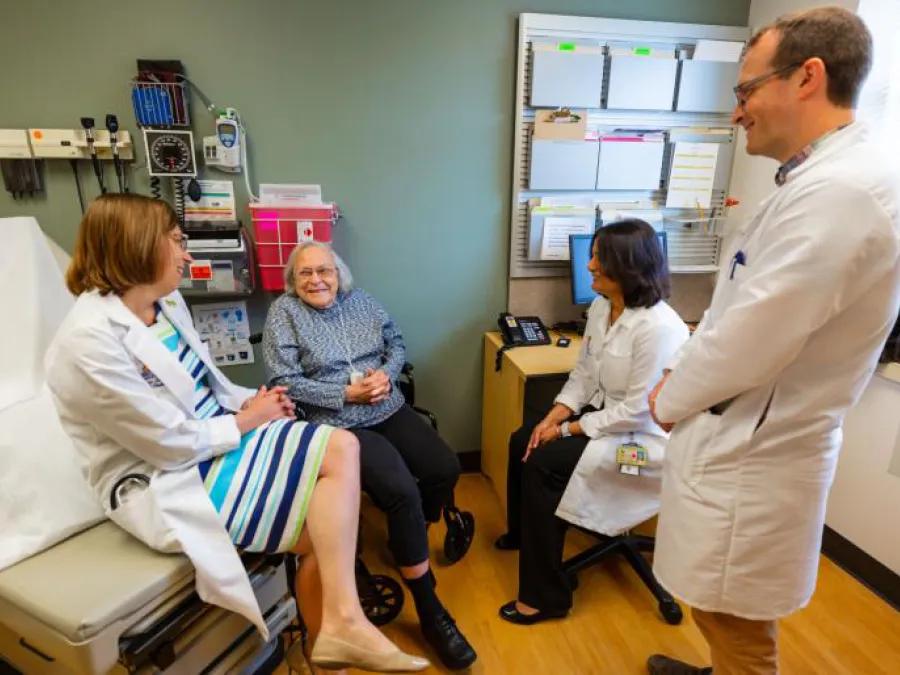
Senior Internal Medicine residents rotate through our geriatrics outpatient clinics for a half-month and may electively request a full month of geriatrics. In addition, there are electives available in both geriatric and palliative medicine, to gain further insight and experience into these important and emerging fields.
Geriatrics Ambulatory Residency Rotation
As the population ages, physicians are increasingly asked to respond to the special, complex needs of the older adult. During the Geriatrics Ambulatory Residency Rotation, residents will be introduced to the care and management of geriatric patients. Faculty geriatricians assist residents in understanding the aging process as it influences health and function. The rotation provides significant depth, with clinical experiences in numerous specialties to address the wide range of issues affecting older patients.
Geriatrics Consultation Rotation (Elective)
This rotation provides experience in caring for frail, complex elderly patients in an inpatient setting, in both the hospital and sub-acute settings.
Geriatric Evaluation and Management Unit Rotation
During this rotation, residents will gain experience in caring for older adults outside of the acute care or clinic settings - at the Community Living Center of the Ann Arbor VA hospital. This rotation is mandatory for residents with a minimum one-half month assignment during HO 2/3.
Palliative and Hospice Care Rotation (Elective)
Physicians must provide compassionate, individualized care for dying patients. The special needs of dying patients and their families are best addressed through dedicated training under the direction of experienced hospice faculty. During this block rotation, residents are introduced to multidisciplinary care for dying patients and their families. This elective is available for residents at the HO2/3 levels.
Medical Student Education
Several educational experiences in geriatric physiology and clinical medicine are standard components of the medical school curriculum at the University of Michigan. Geriatric content is taught across the four years of medical school to allow students to have a comprehensive experience rather than isolated, infrequent blocks of teaching. Content and skills taught in the pre-clinical years are used as a foundation to build on and reinforce clinical activities in the M3 and M4 year that focus on assessment of function in the inpatient and outpatient setting.
Year One-Two
Students visit clinics to observe clinical interactions between patients and caregivers and meet in focus groups to analyze the interactions. Later in the M1 year, students participate in small group sessions that introduce physical examination skills required to perform a Geriatric Functional Assessment.
Year Two-Three
Students practice clinical examination of the older patient using a Geriatric Functional Assessment Standardized Patient Instructor (GFA SPI) for formative feedback, or role-playing sessions in small groups. The skills taught in this session are re-enforced in the M3 year in the outpatient Geriatrics Center Clinics and inpatient rotations on Internal Medicine at the Ann Arbor VA and the University Hospital. A required write-up of a geriatric patient allows students to practice documentation skills and get feedback from faculty.
Year Four
During the M4 year, three month-long electives in geriatrics allow some students to have a more intensive experience in geriatric medicine or geriatric education in a variety of venues. Students can participate in interdisciplinary care of geriatric patients as part of the Geriatric Inpatient Consult Team (GICT) at the University of Michigan Health System or can obtain experience in caring for patients in sub-acute care in the Ann Arbor VA as part of a sub-internship in geriatric medicine. Students in the VA elective also have the opportunity to round with the Geriatric Consult Team and the Palliative Care Team, and care for a variety of patients with chronic disease, rehabilitation needs, and some admitted to inpatient hospice. An elective in geriatric medicine education research offers an opportunity to develop curriculum modules that highlight geriatric issues. Two new M4 electives in long term care and geriatric anatomic pathology are under development.
Predoctoral research training in the biology of aging is also available through the U-M Geriatrics Center's Research Training in Biogerontology Program.
The U-M Geriatrics Standardized Patient Assessment allows medical students and house officers to gain geriatrics experience in a realistic setting with assessment and feedback from trained patient volunteers who act as geriatric patients. The program provides:
- Online portfolio to track and evaluate students' progress, knowledge, and skills
- Measurement and development of patient communication skills
- Evaluation and enhancement of skills in functional assessment
Explore Your Training Opportunities
At Michigan Medicine, you’re joining a community where collaboration, curiosity and excellence shape everything we do. Train alongside leaders in medicine and research, grow with mentors who invest in your success, and be part of teams driving meaningful change in health care.
Featured News & Stories

Amy S. Kelley, MD, MSHS, appointed Associate Dean for Population Science

Dr. Amy Kelley named chief of Geriatric and Palliative Medicine