Integrated Program for Cutaneous Immune-Stromal Interactions in SLE (IPCISS)
The U-M Medical School Department of Internal Medicine Division of Rheumatology Integrated Program for Cutaneous Immune-Stromal interactions in SLE (IPCISS) is a research center dedicated to understanding the drivers of and improving the treatment for cutaneous and systemic lupus.
The center has four main components: Two projects, a Bioinformatics and Integrated Omics Pipeline for Stromal and Immune Interaction (BIOPSII) core and an administrative core to facilitate organization and patient engagement with the center.
Research
Project Lead: Johann Gudjonsson, MD, PhD
Our understanding of how the different cells in the skin contribute to inflammation in cutaneous manifestations of lupus (CLE) remains incomplete. Our preliminary data indicate a highly dynamic crosstalk between stromal cells and immune cells that may be critical both in priming disease activity in the skin as well as facilitating relapse. Aims to be investigated include 1) dissect the crosstalk between keratinocytes (KCs), fibroblasts (FBs) and endothelial cells with immune cells and role in maintaining interferon (IFN) responses; 2) map the spatial context in stromal and immune cell interactions in shaping inflammatory responses in CLE; and 3) identify epigenetic modifications and “inflammatory memory” in stromal skin cells.
Project Lead: J. Michelle Kahlenberg, MD, PhD
UV light exposures are a frequent trigger for skin and systemic inflammation in SLE patients3,4. This project will build upon an established collaborative working group seeking to understand the etiologies of abnormal UV responses in SLE patients. Our preliminary data point to dysregulation of key inflammatory and cell proliferative pathways that lead to the following research aims:
- Map the infiltrate and expression changes within SLE and HC skin after UV exposure
- Identify the role of UV-induced extracellular vessicles (EVs) in driving KC-immune crosstalk
- Determine how UV exposure modulates inflammatory memory within keratinocytes
Director: Lam C. Tsoi, PhD
Technology is making it easier to get detailed, cellular level data from human specimens, but the real challenge is in the meaningful integration and interpretation of the data. We will harness our expertise and developed pipelines in this arena to offer bioinformatics services that will focus on integration of Single-cell and Spatial Seq data: spatial integration of cell-cell interactions; integration of other skin relevant -omic data (cytokine signatures (KCs/FBs); cellular signatures; UV signature data; GWAS data; and epigenetic data (methylation, histone, ATAC-seq) to facilitate successful completion of both proposed projects.
The Administrative Core will:
- provide leadership and oversight for the project
- develop and enact effective management strategies
- effectively disseminate information regarding the project
build and administer a robust Enrichment Program to benefit the IPCISS
Integrated Approach to Skin Inflammation Research
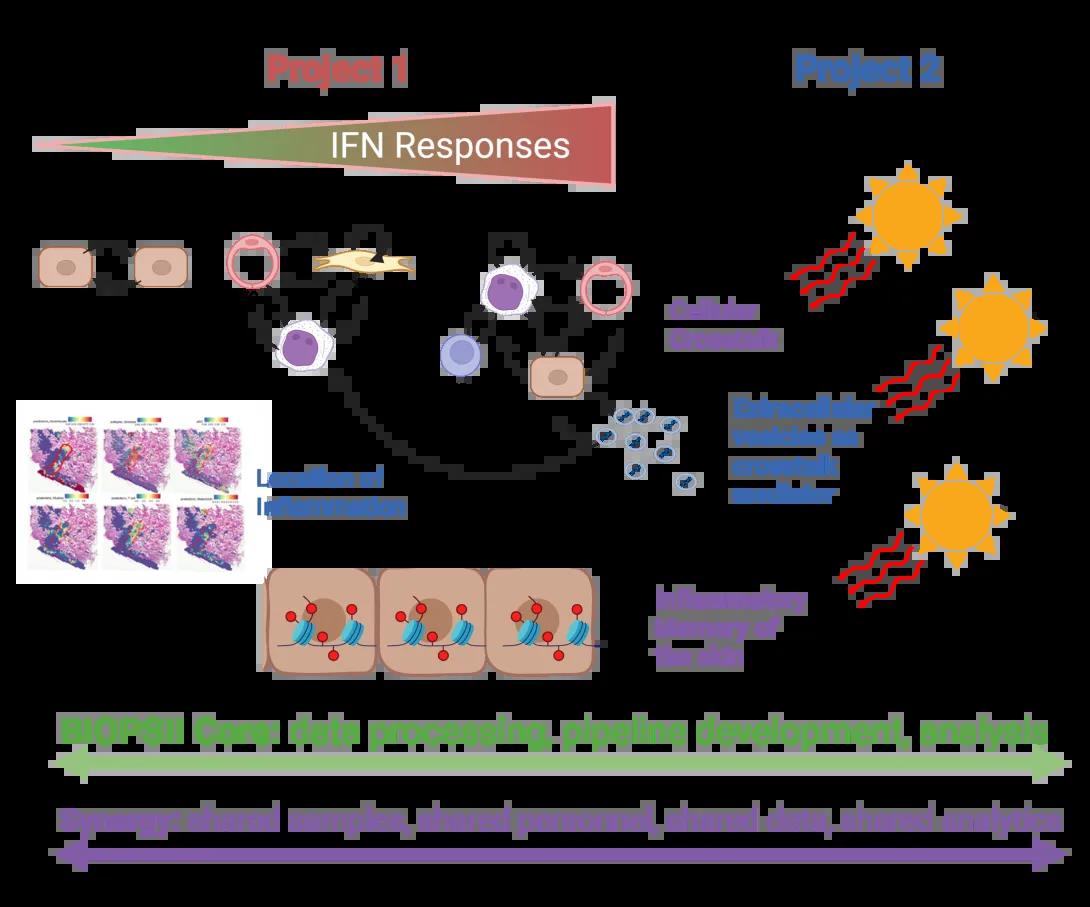
The image is an illustrated scientific diagram, organized into two main sections labeled "Project 1" (on the left, in dark red) and "Project 2" (on the right, in dark blue). Between these two sections, arrows, icons, and colored text describe interactions, research focus and shared resources.
The graphic is a conceptual illustration of two related research projects (Project 1 and Project 2) connected by a core and synergy framework.
At the top center, there are two labeled sections:
Project 1 (on the left, red text) focuses on IFN (interferon) responses. A triangular gradient arrow indicates increasing IFN responses from left to right.
Project 2 (on the right, blue text) focuses on sun exposure and skin inflammation. There are three yellow suns with red rays to symbolize ultraviolet (UV) exposure, connected to the immune cell interactions shown in the middle.
Supporting Elements:
- BIOPSII Core (green text, bottom): Spans across both projects with a horizontal arrow. It highlights data processing, pipeline development, and analysis.
- Synergy (purple text, below core): Another horizontal arrow stresses collaboration across the projects with shared samples, shared personnel, shared data, and shared analytics.
Faculty Collaborations
Upcoming Events
Internal Medicine Grand Rounds
Internal Medicine Grand Rounds
Internal Medicine Grand Rounds
Internal Medicine Grand Rounds
Internal Medicine Grand Rounds
Internal Medicine Grand Rounds
Internal Medicine Grand Rounds
Outreach & Engagement
- Publicly Engaged Research Core (PERC) | University of Michigan Medical School: To help ensure that everyone can benefit from advancements in treatments, PERC is dedicated to amplifying the insights of those with lived experience of chronic pain into research, intervention development, and clinical care.
- Conquer Lupus: A place where warriors and their communities can find resources for living with lupus.
Event Spotlight
- IPCISS Speaker Series - Lam (Alex) Tsoi, PhD “Building Spatial Analytics for Inflammatory Skin Diseases”
Wednesday, September 23, 2026
NCRC10 Research Auditorium & Zoom (Meeting ID: 962 0400 2124) - 2026 Lupus Conference
Saturday, September 26, 2026
UM Detroit Center (3663 Woodward Ave., Detroit, MI)
Join Our Newsletter List
Sign up for our newsletter to learn more about our work.
Explore Our Publications
Review a collection of publications from our team of researchers.
Program Leadership

J Michelle Kahlenberg MD, PhD

Johann E Gudjonsson, MD, PhD

Lam (Alex) C Tsoi, PhD

Celine Berthier, PhD

Dominique Kinnett-Hopkins, PhD
Director, Translational Physical Activity Laboratory
Advisory Board

Matthias Kretzler, MD

Robert L. Modlin, MD
Professor of Microbiology, Immunology, and Molecular Genetics
Vice Chair for Cutaneous Medicine and Dermatologic Research
UCLA David Geffen School of Medicine